The Best AI Music Generation API in 2026
Comparing AI music generation APIs in 2026: MiniMax Music, ElevenLabs Music, and Suno/Udio-style consumer tools, on vocals, control, and billing.
For software that has to generate music on demand, not a person clicking a web app, the best AI music generation API in 2026 is the one with a real HTTP endpoint, explicit control over lyrics versus instrumental, and metered per-call billing. MiniMax's Music 2.6 fits that description, and running it through Monid means it bills per call from the same wallet as ElevenLabs Music and hundreds of other endpoints. If a human is going to sit and tweak tracks by hand, a consumer tool like Suno or Udio is the better buy. The rest of this post is the honest version of that trade.
TL;DR
- If code generates the track: MiniMax Music 2.6 exposes a clean
/v1/music_generationendpoint with aprompt, optionallyrics, and anis_instrumentalswitch, so vocal and instrumental paths are one flag apart. - If a person makes the track: Suno and Udio are consumer studios with editors, stems, and remix loops. Their API access is limited or waitlisted, so they are not the pick for automated pipelines.
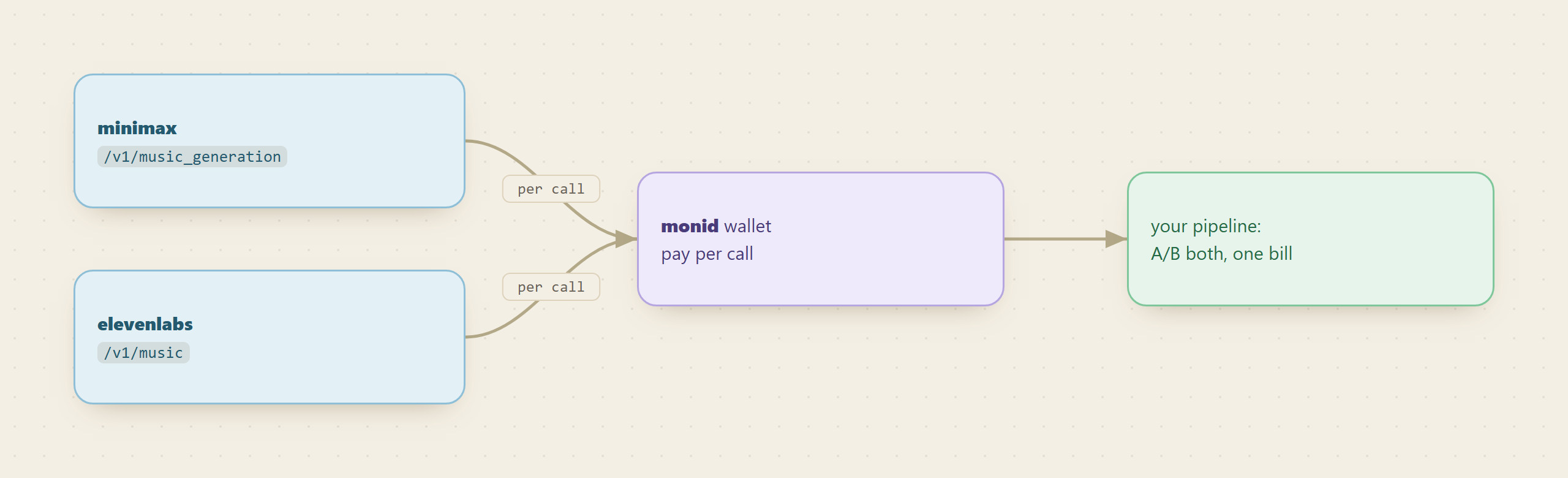
- The close peer: ElevenLabs Music is a credible API sibling with strong vocal quality. On Monid it sits on the same wallet, so you can A/B the two without a second signup.
- Control is the real axis: MiniMax supports
[Verse]/[Chorus]structure tags in lyrics, which is what separates a usable song from a 30-second loop. - Billing shape matters: MiniMax Music meters per call (one call, one song). Consumer tools sell monthly credit subscriptions. For bursty automated use, per-call wins.
The real split: an API you call versus a studio you sit in
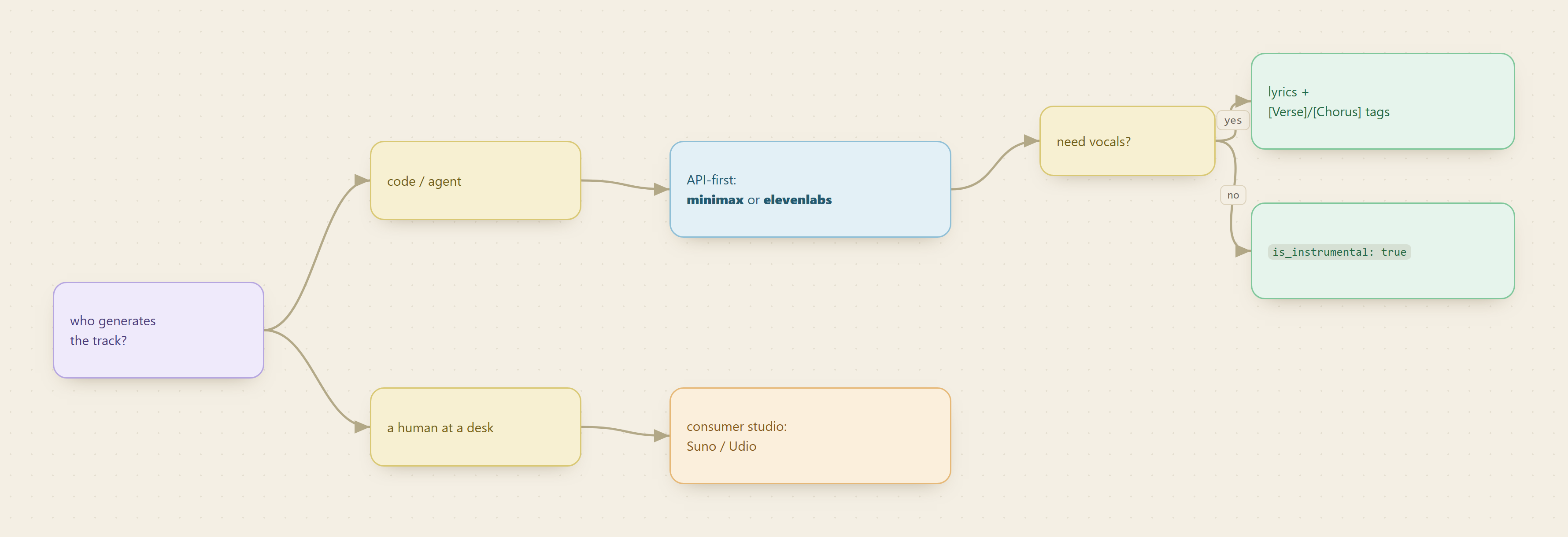
Every option here can produce a finished song. The line that actually matters is who or what is driving. Suno and Udio are built for a human in a browser: you type a prompt, you get a track, you regenerate, you nudge the lyrics, you pull stems. That loop is excellent, and if a person is in the seat it is hard to beat.
The moment the caller is code, that loop is the wrong shape. An agent generating background music for a product demo, a batch job scoring 200 short videos, or a game that needs a fresh instrumental per level does not want a studio. It wants a POST body and a returned audio URL. Suno's API access has been gated and inconsistent for third-party automation, and Udio is similar, so both are hard to standardize a pipeline on even when the audio quality is there.
MiniMax and ElevenLabs are the opposite: API-first. You send JSON, you get a song. That is the whole reason they show up in a post about the best music generation API rather than the best music generation app.
The 2026 field, side by side
| Option | Vocals vs instrumental | Lyric and structure control | Access shape | Where cost lives |
|---|---|---|---|---|
| MiniMax Music 2.6 on Monid | Both: is_instrumental flag flips vocal or instrumental in one call | lyrics field with [Verse] / [Chorus] / [Bridge] tags, or auto-written from the prompt | Real HTTP API, one call returns one song | One Monid wallet, per call |
| ElevenLabs Music on Monid | Both, strong vocal fidelity | Prompt-led, with composition control | Real HTTP API | Same Monid wallet, per call |
| Suno | Both, high consumer quality | In-app lyric editor, stems, remix | Consumer app; API gated / limited | Monthly credit subscription |
| Udio | Both, high consumer quality | In-app editing, extend, remix | Consumer app; API limited | Monthly credit subscription |
To be fair to the field: Suno and Udio produce excellent audio, and for a solo creator making a handful of songs a month the subscription math and the editor are genuinely nice. The table is not a quality ranking. It is a "what is callable from code, and how does it bill" ranking, which is the question that matters when the caller is software.
Control: lyrics, structure tags, and the vocals switch
The gap between a toy and a tool is control, and this is where the MiniMax endpoint earns its place. Three fields do the work.
is_instrumental is the top-level fork. Set it to true and you get music with no vocals, and only a prompt describing style, mood, and scenario is required. That is the common case for demo backing tracks, game loops, and video beds where a vocal would fight the voiceover.
lyrics is required when you want singing, and it accepts real song structure. You separate lines with \n and mark sections with tags like [Intro], [Verse], [Pre Chorus], [Chorus], [Bridge], and [Outro]. Those tags are why the output can be a song with a build and a hook rather than a flat 30-second wash. Write your own lyrics (do not paste copyrighted lyrics you do not own), and the model follows the arrangement you tag.
lyrics_optimizer is the shortcut: leave lyrics empty and let the model write them from the prompt. Fine for scratch tracks, weak when the words must say something specific. Default to instrumental for beds, hand-written tagged lyrics for anything a listener will parse.
One practical limit to plan around: MiniMax returns the audio as a CDN URL that expires after 24 hours. For any pipeline, download and store the file the moment the call returns. Do not treat the returned link as durable storage.
Length, licensing, and the shape of the bill
Length: these models generate complete songs, not multi-minute albums, and MiniMax produces one song per call. Many variations means many calls, which is exactly what per-call billing is good at.
Licensing is the part to read before you standardize, because it is where the vendors diverge and where the risk lives. Consumer tools tie commercial-use rights to paid tiers, and the industry is under active copyright scrutiny (the 2024 major-label suits against Suno and Udio are still the reference point). Confirm the commercial terms of whichever provider you pick against your actual use, especially for anything you ship in a product for years.
Billing shape is the cleanest MiniMax advantage for automated use. MiniMax Music meters per call: one call, one charged unit, one song. No monthly seat, no credit bucket that resets, no waste when volume is bursty. Consumer subscriptions are the opposite bet, cheap if you generate steadily, wasteful in spikes. See the current per-call rate for MiniMax Music and ElevenLabs Music, before you run either, on monid.ai/tools.
The honest caveat
An API is not always the right buy. If a human is going to sit and craft each track, listen, regenerate, and pull stems, a consumer studio like Suno or Udio gives that person a better loop than any raw endpoint will, and paying for API plumbing you will not script is waste. Match the tool to the driver: software behind the wheel wants an endpoint, a person behind the wheel wants a studio.
Run MiniMax Music on Monid
Monid is a pay-per-call data API marketplace: one interface to discover, inspect, and run hundreds of external endpoints without a separate signup for each vendor.
For agents
Grab an API key at app.monid.ai, then paste this to your agent and hand it the key:
set up https://monid.ai/SKILL.md
It learns the whole discover, inspect, run workflow itself. More details in the agent quickstart.
For humans
npm install -g @monid-ai/cli
monid keys add --label main --key <your-api-key>
More details in the CLI quickstart.
Then find the endpoint, read its schema for free, and run it. Only the run bills.
monid discover -q "music generation"
monid inspect -p minimax -e /v1/music_generation
monid run -p minimax -e /v1/music_generation -i '{"prompt":"upbeat lo-fi hip hop for a product demo","is_instrumental":true}' -w
That single run returns one instrumental track as a CDN URL. To get vocals, drop is_instrumental and pass a lyrics string with [Verse] and [Chorus] tags. To try the sibling, swap the provider to elevenlabs and the endpoint to /v1/music on the same wallet.
Decision heuristic
Answer one question: is the caller code or a person? If code generates the track, pick an API-first model, default to MiniMax Music 2.6 for its clean vocals-versus-instrumental switch and structure tags, keep ElevenLabs Music one flag away on the same Monid wallet for A/B, and confirm licensing before you ship. If a person crafts each track by hand, go straight to Suno or Udio. Billing follows the same logic: bursty automated volume wants per-call, steady daily hand-work wants a subscription.
FAQ
Which AI music generation API is best in 2026?
For automated, code-driven generation, MiniMax Music 2.6 is a strong default: a real /v1/music_generation endpoint, an is_instrumental switch, and lyric structure tags. ElevenLabs Music is a credible peer. For a human crafting tracks by hand, Suno or Udio are better, but their API access is limited.
Can I generate instrumental music without vocals?
Yes. On MiniMax set is_instrumental to true and provide only a prompt describing style and mood. No lyrics needed.
Can I control song structure like verse and chorus?
Yes. Put lyrics in the lyrics field and mark sections with tags like [Verse], [Chorus], [Bridge], and [Outro]. Separate lines with \n. You can also let the model auto-write lyrics from the prompt.
How much does AI music generation cost through Monid? It is pay-as-you-go, metered per call, with one call producing one song, on one wallet shared with every other endpoint. Current rates for MiniMax Music and ElevenLabs Music are on monid.ai/tools.
Why run MiniMax or ElevenLabs music through Monid instead of directly? Both music endpoints bill from a single balance and interface shared with hundreds of other data endpoints, so you can A/B them without a separate vendor signup and manage one bill. Discovering and inspecting endpoints is free; only the run is billed.