The Best OCR API for Messy Real-World Images in 2026
Classic OCR (Tesseract, cloud OCR) versus vision-LLM OCR, with a clear pick for skewed photos, receipts and handwriting.
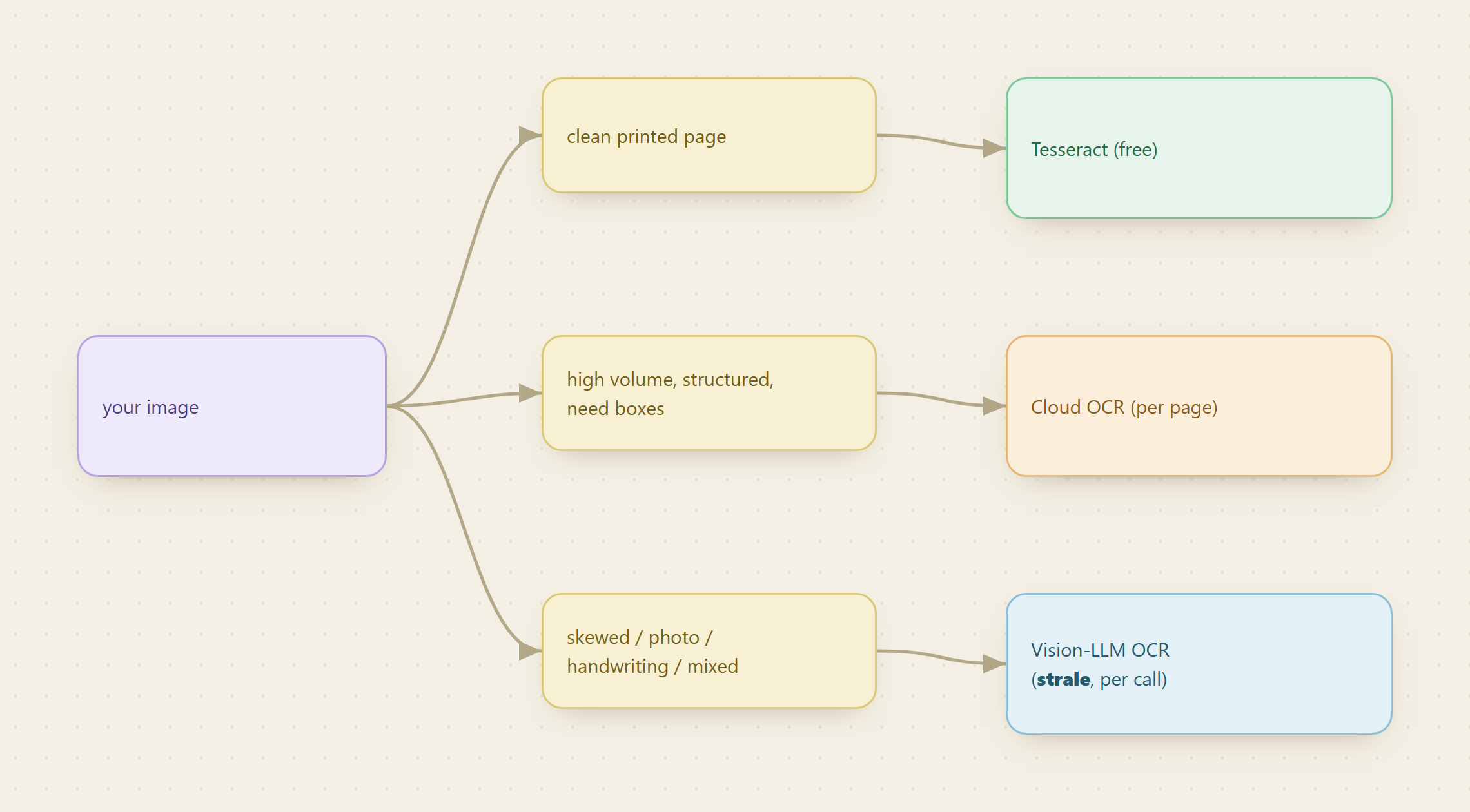
For clean, flat, printed pages, classic OCR is still the right buy and often free. For the messy inputs that actually show up in production (a receipt shot at an angle, a screenshot with mixed UI chrome, a handwritten note), a vision-LLM OCR that reads the image the way a person would is the more reliable pick in 2026. The honest split is that simple: match the engine to how clean your inputs really are, not to how clean you wish they were.
A vision-LLM OCR like Strale's image-to-text runs OCR through Claude vision, so it tolerates skew, glare, and layout noise that trips a template-based engine. On Monid it bills per call from the same balance as the rest of your data tools, so you can test it against Tesseract and a cloud OCR on your own worst images before you commit. Monid is the OpenRouter for agent tools: one interface to discover, inspect, and run over a thousand tools without a signup per vendor.
TL;DR
- Clean printed pages: Tesseract is free and fast, and hard to beat on cost. It gets brittle the moment the input is skewed, low-contrast, or handwritten.
- High-volume structured documents: a cloud OCR (Google Document AI, AWS Textract, Azure) is accurate and returns bounding boxes and layout, but it is rigid, per-page priced, and needs its own account and IAM setup.
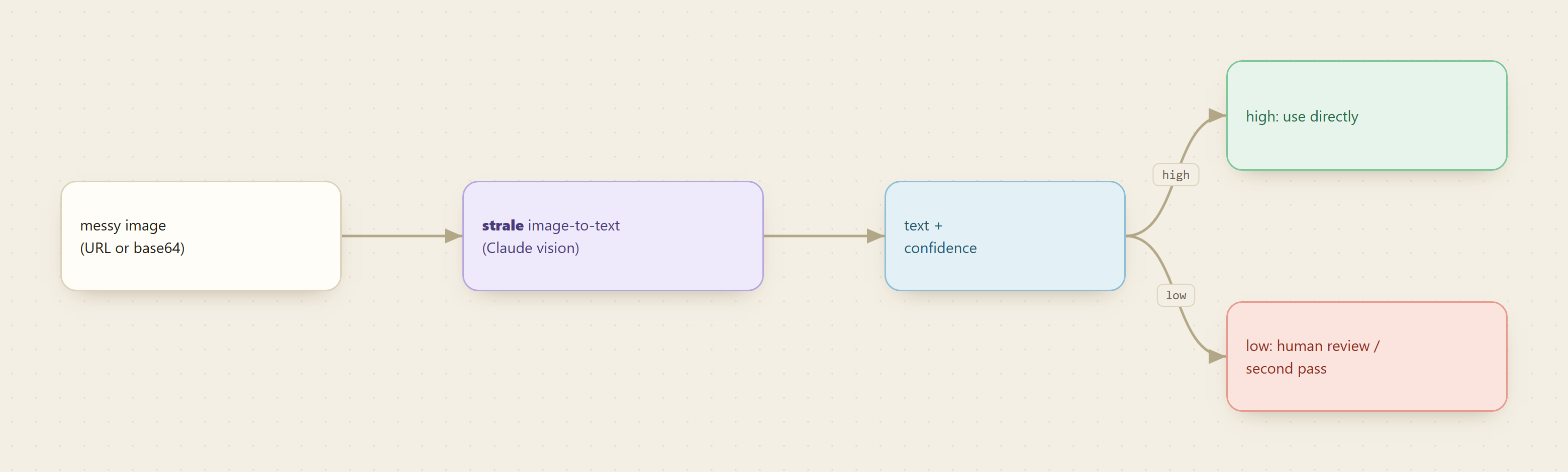
- Messy, varied, low-volume inputs: a vision-LLM OCR (Strale's image-to-text, OCR via Claude vision) reads the image holistically, handles handwriting and photos, and returns clean text plus a confidence score.
- Billing shape decides as much as accuracy: Tesseract is free compute you host, cloud OCR is per page with a contract, vision-LLM OCR is a few cents per call with no floor.
- Discover and inspect are free on Monid. You only pay on
run. Magnitudes live at monid.ai/tools.
The real question: how clean are your inputs, honestly
OCR benchmarks are usually run on clean scans, and that is where the comparison misleads people. On a flat, high-contrast, printed page, almost everything works, including the free option. The differences only appear once the input degrades, and real-world inputs degrade constantly: a phone photo of a receipt with a curled edge, a screenshot that mixes a table with a toolbar, a shipping label under plastic, a doctor's handwriting.
Classic OCR engines were built for the clean case. They detect character shapes against expected patterns, which is exactly why they wobble when the page is rotated, the lighting is uneven, or the strokes are not machine-printed. Vision-LLM OCR takes a different path: it looks at the whole image and reasons about what the text says, the way a person glancing at a crumpled receipt still reads "total 41.80" without squinting at each glyph. That holistic read is the reason it holds up on messy inputs, and also why it is overkill for a stack of clean PDFs.
📖 See also Ingesting Mixed Documents for LLM Embedding
The 2026 field, side by side
| Option | Handles messy inputs? | What you get back | Billing shape | Setup cost |
|---|---|---|---|---|
| Tesseract | Poorly. Needs deskew, denoise, thresholding preprocessing | Raw text (and boxes with config) | Free compute you host | You run and tune it |
| Cloud OCR (Document AI, Textract, Azure) | Well on documents, less so on casual photos and handwriting | Text plus bounding boxes, layout, key-value pairs | Per page, often with tiers or minimums | Cloud account, IAM, SDK |
| Vision-LLM OCR (Strale image-to-text) | Well: skew, glare, handwriting, screenshots, mixed layout | Clean text plus a confidence score | Per call, pay-as-you-go, no floor | One Monid key |
To be fair to the classics: this is not a case of the new thing beating the old thing everywhere. Tesseract is genuinely excellent and free on the inputs it was designed for, and if you can control your capture (a document scanner, a fixed camera rig, generated PDFs) you should probably use it and pocket the savings. Cloud OCR is the right answer at high volume when you need positional data, because a vision-LLM returns text, not pixel-accurate bounding boxes. The vision-LLM only pulls ahead on the messy, heterogeneous, lower-volume slice, which happens to be where a lot of real product OCR actually lives.
Which returned fields matter
The output shape is where the three approaches diverge most, and it should drive your choice more than a headline accuracy number.
Tesseract hands you text, and optionally word-level boxes and confidences if you configure the output format. Reliable, minimal, yours to post-process.
Cloud OCR is the field-rich option. Textract and Document AI return not just text but bounding polygons, reading order, tables reconstructed as rows and columns, and key-value pairs for forms. If your downstream job is "find the invoice number and the line-item table and their positions," that positional structure is the product, and a vision-LLM giving you a clean transcription is not a substitute.
Strale's image-to-text returns the extracted text plus a confidence score. That confidence field earns its keep in a messy-input pipeline: it lets you route low-confidence reads to a human or a second pass instead of silently trusting a bad extraction. What you do not get is per-word coordinates, so if layout geometry is the point, this is the wrong tool and cloud OCR is the right one.
Run vision-LLM OCR on Monid
For agents
Grab an API key at app.monid.ai, then paste this to your agent and hand it the key:
set up https://monid.ai/SKILL.md
It learns the whole discover, inspect, run workflow itself. More details in the agent quickstart.
For humans
npm install -g @monid-ai/cli
monid keys add --label main --key <your-api-key>
More details in the CLI quickstart.
Read the schema and price for free, then run one image. This endpoint takes query params, so pass the image with --query:
monid discover -q "ocr image to text"
monid inspect -p api.strale.io -e /x402/image-to-text

monid run -p api.strale.io -e /x402/image-to-text \
  --query '{"image_url":"https://example.com/receipt.png"}' -w
That returns the text read off the image plus a confidence score. Swap image_url for a public URL of your own worst input (the crumpled receipt, the whiteboard photo, the handwritten form) to see how it does on the case that matters. If your image is not web-hosted, pass it inline as base64 instead of image_url. See the endpoint on Strale for the current field details.
What a call actually costs, in magnitudes
We do not print rates, because the unit that matters is cost per usable extraction, and that depends on your input mix. The reasoning that survives any price change:
- Tesseract is free per image on compute you already pay for. The hidden cost is engineering: deskew, denoise, and threshold tuning, plus the retries and manual fixes on the inputs it fumbles. Free per call is not free per correct read.
- Cloud OCR is priced per page, sometimes with tiered minimums or a monthly floor. At high, steady volume that unit price is excellent. At low or bursty volume you can end up paying for capacity you do not use, plus the account and IAM overhead.
- Vision-LLM OCR on Monid is a few cents per call, pay-as-you-go, at the price shown before you run, with no floor and no per-vendor signup. That is more per image than a cloud OCR page at scale, and the trade you are buying is robustness on messy inputs and zero setup. Current magnitudes for this and every endpoint are on monid.ai/tools.
The crossover is volume and cleanliness together. Clean and high-volume favors the cheap per-page or free options. Messy and low-to-medium volume favors paying a few cents a call to actually get the read right the first time.
📖 See also A Free API to Extract Page Content for RAG
The honest caveat
A vision-LLM reading text is a probabilistic model, not a deterministic parser. It can misread a digit or quietly "correct" a value to something more plausible, and on a total or an account number that is a real risk that a template OCR, for all its brittleness, does not have in the same way. The confidence score helps you catch the shaky reads, but for anything where a single wrong character is expensive, keep a human or a validation rule in the loop. It also does not return coordinates, so it is not a drop-in for a layout-extraction pipeline.
None of the three is "the" OCR API. The right one is a function of your inputs.
The decision heuristic
- Inputs are clean, printed, and you control capture: use Tesseract, pay nothing, tune preprocessing.
- Inputs are documents at high volume and you need positions, tables, and key-value pairs: use a cloud OCR and accept the per-page contract and setup.
- Inputs are messy, varied, or handwritten and volume is low to medium: use a vision-LLM OCR like Strale's image-to-text, priced per call, and gate on the confidence score.
Because all of this runs through one Monid wallet, you do not have to decide from a spec sheet. Point each engine at your ten worst real images, compare the transcriptions by hand, and let your own inputs pick the winner.
FAQ
What is the best OCR API for messy images in 2026? For skewed photos, receipts, screenshots, and handwriting, a vision-LLM OCR that reads the image holistically (like Strale's image-to-text running OCR via Claude vision) is the most reliable pick. For clean printed pages, Tesseract is free and hard to beat, and for high-volume structured documents a cloud OCR with layout output wins.
Is Tesseract good enough for real-world OCR? On clean, flat, high-contrast printed text, yes, and it is free. It gets brittle on skew, glare, low contrast, and handwriting unless you add deskew and denoise preprocessing, so its "free" often hides real engineering and correction cost.
Does vision-LLM OCR return bounding boxes?
Strale's image-to-text returns extracted text plus a confidence score, not per-word coordinates. If your pipeline needs positional data, tables, or key-value geometry, a cloud OCR is the better fit. Confirm the exact response with monid inspect -p api.strale.io -e /x402/image-to-text.
How much does OCR cost through Monid? It is pay-as-you-go at the price shown before you run, on one balance with hundreds of other endpoints. Expect a few cents of magnitude per image for the vision-LLM route. Discover and inspect are free. Current rates are on monid.ai/tools.