The Best Text-to-Speech API in 2026
Comparing the best text-to-speech APIs in 2026: ElevenLabs, OpenAI TTS, Google and Azure, and a local open model, on voice, latency, and billing.
The best text-to-speech API in 2026 is not one product, it is whichever billing shape matches your volume, and for most teams that ship real voice output the honest default is ElevenLabs for quality and expressiveness, OpenAI TTS when you already live in that stack, the cloud giants when you need coverage and compliance, and a local open model only when you can pay in GPU time instead of dollars. The tie-breaker nobody talks about is the standing plan. Running ElevenLabs metered through Monid means you use the strongest voices per character, from the same balance as your other data endpoints, without a monthly ElevenLabs subscription sitting idle between bursts.
Monid is the OpenRouter for agent tools: one key and one balance to discover, inspect, and run over a thousand tools without a separate signup per vendor. That includes ElevenLabs /text-to-speech, billed per character, so you can put its output next to a plan-based OpenAI voice and decide with your ears and your invoice instead of a pricing page.
TL;DR
- ElevenLabs leads on voice realism and expressiveness, with three models to trade quality against latency and cost. On Monid it bills per character, no standing plan.
- OpenAI TTS is the easy pick if your app already calls OpenAI. Fewer voices, solid quality, one more thing on an account you already have.
- Google Cloud and Azure win on language coverage, SSML control, and enterprise compliance. Setup is heavier and voices sound more "assistant" than "human".
- Local open models (Kokoro, XTTS-style) cost zero per character but cost you GPU, latency tuning, and ops. Right for high, steady volume, wrong for a quick feature.
- The Monid tie-breaker: metered ElevenLabs on one balance, so a bursty or seasonal voice workload never pays for a month it does not use.
The real split: per-character meters versus standing plans
Voice quality gets the headlines, but the decision that survives a year of production is the billing shape. There are two, and your workload sits on one.
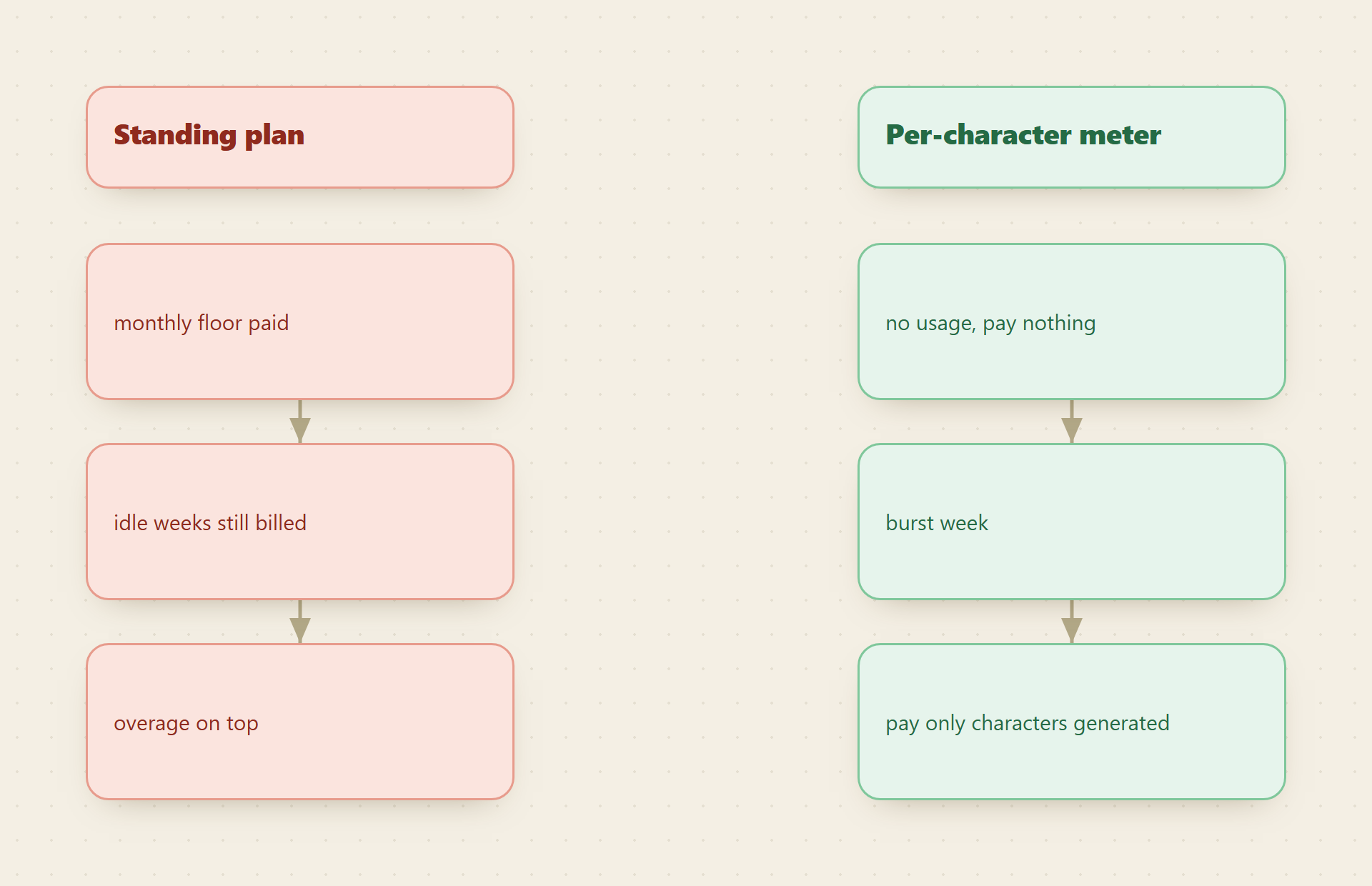
A per-character meter charges for exactly the audio you generate. ElevenLabs through Monid is priced per character, at a magnitude of cents per thousand characters, with the model you pick moving the rate. Generate nothing for a week and you pay nothing. This is the right curve for bursty work: shipped-order notifications, a batch of demo voiceovers, an agent that speaks only when a user asks.
A standing plan charges a monthly floor whether you use it or not, then meters overage. Direct ElevenLabs subscriptions, and most SaaS voice products, sit here. The floor is fine when your volume is high and steady, and pure waste when it is not. OpenAI TTS is a softer version: no dedicated voice subscription, but it lives inside an OpenAI account with its own usage billing and rate limits.
The cloud giants meter per character too, but the real cost is onboarding. Google Cloud and Azure both want a project, a service account or key, IAM roles, and a console you learn once and forget. That overhead pays off at enterprise scale and is friction you feel for a weekend feature.
The 2026 field, side by side
| Option | Voice quality | Latency | Languages | Billing shape |
|---|---|---|---|---|
| ElevenLabs on Monid | Top tier, most expressive; three models | Low on Flash, higher on quality model | Multilingual v2 and 70+ on v3 | Per character, one Monid wallet |
| OpenAI TTS | Strong, natural, fewer voices | Low, streaming supported | Broad, tied to model | Inside your OpenAI account usage |
| Google Cloud / Azure | Good, more "assistant" than human | Low, mature infra | Widest coverage, deep SSML | Per character plus cloud onboarding |
| Local open model | Good and improving, less consistent | You own it; depends on GPU | Model-dependent | Zero per character, you pay GPU and ops |
To be fair to the field: none of these is bad. OpenAI TTS is genuinely good and nearly free of integration cost if you are already there. Google and Azure produce clean, reliable speech and are often the only option that clears a procurement or data-residency requirement. A local model like Kokoro can be excellent and cost nothing per call once it runs. ElevenLabs earns the default for expressiveness and voice range, not because the others cannot speak.
Voice quality, latency, and languages, and which model to reach for
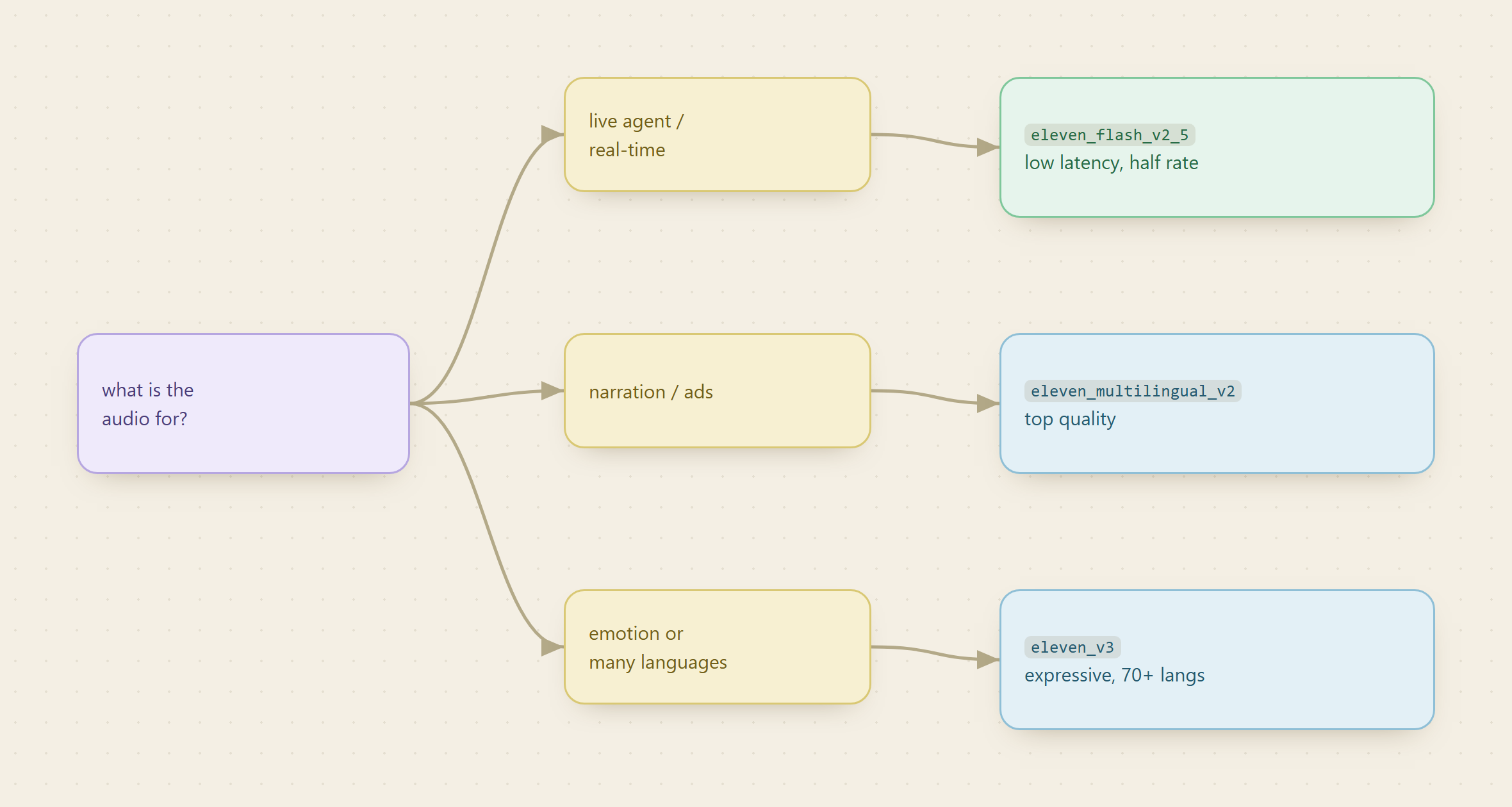
ElevenLabs ships three models on the same endpoint, and picking the right one is most of the skill. eleven_multilingual_v2 is the quality anchor: use it for anything a customer hears, like narration, ads, character voices. eleven_flash_v2_5 runs at low latency and half the per-character rate of the quality model, which makes it the pick for real-time agents and high-volume notification text where a hair less polish is invisible. eleven_v3 is the most expressive and reaches 70-plus languages, which is the one to reach for when tone and emotion carry the message or when you need a long tail of locales.
Latency and quality trade against each other across every vendor here. If your agent speaks in a live conversation, latency is the spec that matters and Flash or OpenAI's streaming voices are the honest picks. If you render audio ahead of time, latency is irrelevant and you should spend the budget on the quality model. Language coverage is where the cloud giants and eleven_v3 pull ahead of the English-centric defaults, so let your locale list, not the demo reel, decide.
What the call returns, and the fields that matter
The endpoint takes text (1 to 5000 characters, required), model_id, and a voice_id you choose from the provider's /voices list. Longer scripts split across multiple runs, since the 5000-character cap is per call. The run returns an audio object carrying a signed download_link to the MP3, its content_type, and the billed character_count. That last field is the one to log: character_count is your unit of cost, so tracking it per feature tells you exactly where the bill comes from before it surprises you. Read the live schema for free with monid inspect before you script against it, because model names and defaults move.
Where the bill lives, in magnitudes
We do not print rates, because the unit that matters is cost per finished clip, and that depends on your script length and model. The reasoning that survives any price change: ElevenLabs meters per character, at a magnitude of cents per thousand characters, with the quality model and eleven_v3 at roughly double the Flash rate. A short shipped-order line is a fraction of a cent; a full narration script is a few cents. Because it is metered on Monid, a month with no audio costs nothing. Live magnitudes for ElevenLabs and every other endpoint are on monid.ai/tools.
The comparison that decides it is cost per useful minute of audio against your real volume. A standing plan divided by heavy, steady usage can beat a meter. The same plan divided by a feature that fires twice a week is pure waste. Map your volume first, then pick the curve.
📖 See also the pay-per-call pricing breakdown
The honest caveat
Metered is not always the answer. If you generate a very high, steady volume of speech, a committed plan or a local open model amortizes better, and paying per character for millions of characters a day is the expensive path. A local model also keeps audio entirely on your own hardware, which some compliance postures require outright. And no table beats your own ears: voice preference is subjective, so generate the same line on two vendors before you standardize. Model names, voice lists, and defaults also shift, so trust a fresh monid inspect over this post.
Run ElevenLabs TTS on Monid
For agents
Grab an API key at app.monid.ai, then paste this to your agent and hand it the key:
set up https://monid.ai/SKILL.md
It learns the whole discover, inspect, run workflow itself. More details in the agent quickstart.
For humans
npm install -g @monid-ai/cli
monid keys add --label main --key <your-api-key>
More details in the CLI quickstart.
Find the endpoint, read its schema and price for free, then run it. Only the run bills.
monid discover -q "text to speech"

monid inspect -p elevenlabs -e /text-to-speech

monid run -p elevenlabs -e /text-to-speech \
  -i '{"text":"Your order has shipped and arrives Thursday.","model_id":"eleven_multilingual_v2"}' -w
That returns an MP3 with a signed download link and the billed character count. Swap model_id to eleven_flash_v2_5 for low-latency, half-rate output, or set a voice_id you picked from the /voices endpoint to change the speaker.
FAQ
What is the best text-to-speech API in 2026? For expressive, customer-facing voice, ElevenLabs is the strong default, with OpenAI TTS as the easiest pick if you already use OpenAI, and Google Cloud or Azure when you need the widest language coverage or enterprise compliance. A local open model wins only at high, steady volume. Match the choice to your volume and locale list.
Which ElevenLabs model should I use?
Use eleven_multilingual_v2 for top quality, eleven_flash_v2_5 for low latency at half the rate, and eleven_v3 for the most expressive output and 70-plus languages. All three are on the same /text-to-speech endpoint.
How much does text-to-speech cost through Monid?
It is pay-as-you-go, priced per character at a magnitude of cents per thousand characters, on one balance with every other endpoint. The quality model and eleven_v3 run about double the Flash rate. Current rates are on monid.ai/tools.
Why run ElevenLabs through Monid instead of subscribing directly? Same voices, metered per character with no standing monthly plan, on a single balance shared with hundreds of other data endpoints. Discovering and inspecting endpoints is free; only the run bills. That is the right shape for bursty or seasonal voice workloads.