Amazon Product Data API: Buy vs Build an ASIN Feed
Build an Amazon ASIN scraper or buy a metered product-detail feed? A thesis, a comparison table, and per-call cost reasoning for structured JSON.
For a structured feed of Amazon product detail keyed by ASIN, buy it. A metered scraping actor hands back clean JSON (price, list price, discount, availability, star rating with its full distribution, best-seller rank, breadcrumbs, brand, title, bullets, specs, and images) from a bare ASIN, while a do-it-yourself Amazon detail scraper spends its life fighting layout drift, rotating price and buy-box blocks, captchas, and IP bans, then re-breaks on the next redesign. Build your own only when catalog scraping is a permanent core product with staffed maintenance behind it.
That is the whole thesis. The rest of this post argues it fairly, including the cases where building is the right call, and shows the exact command that turns a list of ASINs into structured records through Monid. Monid is the OpenRouter for agent tools: over a thousand tools from one key and one balance, paying only when a run succeeds.
TL;DR
- Buy a metered feed for structured ASIN detail at any scale. The failure surface of a DIY scraper (layout drift, buy-box shuffles, captchas, IP bans) is permanent, and the feed's provider absorbs all of it.
- One endpoint, the Apify actor
/delicious_zebu/amazon-product-details-scraper, takes a mixed array of ASINs and product URLs and returns one billed record per input. - Cost is per input at a fraction of a cent per product, so a catalog of a few thousand ASINs lands in single-digit dollars. Live pricing sits at monid.ai/tools.
- Amazon's own Product Advertising API is free but gated behind an affiliate and sales requirement, is heavily throttled, and returns a star average rather than a full per-ASIN detail record.
- Build in-house only when scraping is a core product you will staff forever, where marginal cost at huge steady volume beats a metered bill.
What actually breaks a DIY Amazon detail scraper
The pitch for building is that a page is just HTML and a parser is a weekend. The reality is that Amazon's product page is not one stable layout. Price sits in a different block for a coupon item than for a subscribe-and-save item, the buy-box swaps between "sold by Amazon" and a third-party seller, and rank and breadcrumbs move as merchandising changes. Add rotating captchas, proxy pools that get flagged, and IP bans that arrive without warning, and the parser you shipped last month starts returning nulls in fields you depend on.
None of that is a one-time fix. It is a maintenance stream. Every layout experiment Amazon runs is a small fire, and a price monitor that silently loses its listPrice field for a week is worse than one that is honestly down, because you keep trusting stale numbers. To be fair to the build route: at huge, steady volume the marginal cost of a scraper you already run approaches the cost of proxies and compute, which can undercut any metered price. That math only holds if you have engineers staffed to keep the parser alive. If catalog scraping is a feature you need but not a product you sell, that staffing is the hidden line item that sinks the build.
📖 See also the PA-API retirement guide
Buy vs build vs the official API
Three honest options, laid against the axes that decide the choice:
| Axis | DIY scraper | Official PA-API | Apify actor via Monid |
|---|---|---|---|
| Access model | Your proxies and parser | Approved Associates account | One key, one balance |
| What breaks it | Layout drift, captchas, IP bans | Losing affiliate eligibility | Nothing on your side |
| Returns full detail JSON? | If your parser holds | No, star average and count | Yes, structured per ASIN |
| Throttling | Whatever your IPs survive | Heavy, tied to sales volume | Per-call, no tier to unlock |
| Maintenance | Yours, forever | Amazon's, but gated | Provider's |
| Cost shape | Fixed staff plus infra | Free but gated | A fraction of a cent per input |
| Best fit | Scraping is your core product | You already drive Amazon sales | Structured detail at any scale |
The official Product Advertising API deserves a fair hearing. It is genuinely free, and if you already push affiliate sales it is the sanctioned path. The catch is the gate: you need an approved Associates account and ongoing qualifying sales to keep access, its rate limits scale with the revenue you send Amazon, and its item response leans on a star average and a review count rather than the rating distribution, discount, and best-seller rank a monitoring or enrichment job needs. It was built to help affiliates sell, not to hand you a per-ASIN detail feed.
The buy path, in one command
The metered route removes the parser from your side of the line entirely. You send identifiers, you get records. Here is how to set it up and run it.
For agents
Grab an API key at app.monid.ai, then paste this to your agent and hand it the key:
set up https://monid.ai/SKILL.md
It learns the whole discover, inspect, run workflow itself. More details in the agent quickstart.
For humans
npm install -g @monid-ai/cli
monid keys add --label main --key <your-api-key>
More details in the CLI quickstart.
Discover and inspect are free, so read the schema before you spend. When you run, you can mix bare ASINs and full product URLs in the same Params array, and you get exactly one billed result per input:
# mix ASINs and product URLs; one billed result per input
monid run -p apify -e /delicious_zebu/amazon-product-details-scraper \
  -i '{"Params":["B00091S3K4","https://www.amazon.com/dp/B077Z99YGY"]}' -w
The -i flag carries the JSON body and -w waits inline so the records come straight back. There is no result-limit parameter to reason about, because results equal inputs. That single rule is what makes the bill predictable before you ever press enter.
Which returned fields do the common jobs
One ASIN fans out into several field groups, and different jobs live in different groups. The actor documentation lists the full response; here is how to read it by intent.
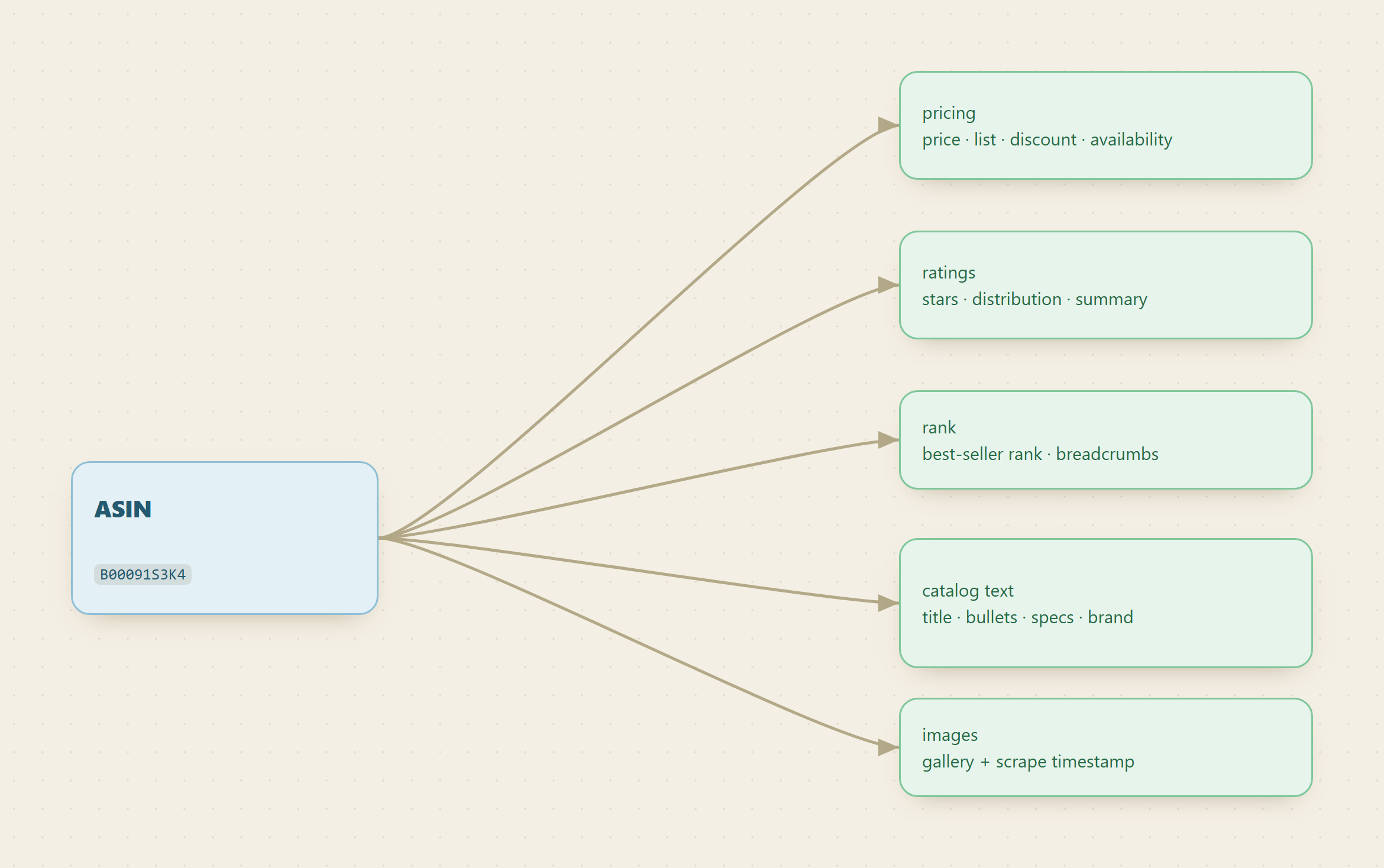
For price monitoring, watch the pricing group: price, list price, and the computed discount, plus availability and the delivery estimate. The gap between price and list price is your promotion signal, so tracking both over time catches a markdown the moment it starts rather than a week later.
For demand validation, read the ratings and rank group: the star rating, the full rating distribution, and the best-seller rank with its category breadcrumbs. The distribution matters more than the average, because a 4.3 built on a wall of fives and a spike of ones is a different product from a flat, quiet 4.3, and only the distribution tells them apart. Best-seller rank plus breadcrumbs puts that product in its category, which is what turns a single record into a demand read.
For catalog enrichment, take the text and media group: full title, description, bullet features, the specifications block, brand and manufacturer and seller, and the image gallery. That is enough to populate your own product pages or a marketplace listing without hand-copying anything, and the recent-purchase cues and review summary round out the merchandising picture.
📖 See also Which Data API Lets You Pay Per Call Instead of a Subscription?
What each option really costs, step by step
Cost is where the thesis gets concrete. Walk the metered path first. Discover costs nothing. Inspect costs nothing, so you confirm the schema and the per-result price for free. Only monid run bills, and it bills per input at a fraction of a cent per product. A ten-ASIN spot check is that fraction times ten. A catalog of a few thousand ASINs is that same fraction times a few thousand, which lands in single-digit dollars for the whole sweep, with nothing hidden in retries or paging. You can compute the bill from the length of your input array before you run. Current per-result pricing is on monid.ai/tools.
Now the build path. Its per-record cost at scale can be lower, but its fixed cost is not the proxies, it is the person. Amortize an engineer's time across the fires (a layout change here, a captcha wall there, a seller-block edge case next quarter) and the true unit cost is dominated by maintenance, not compute. Below a few million pulls a month, the metered feed almost always wins on total cost of ownership because you buy zero maintenance. Above that, and only with staff already in place, the build starts to pay off.
The official API's cost is zero dollars and a real tax elsewhere: you must keep an affiliate account in good standing, you accept throttling tied to your sales volume, and you accept a thinner response. Free is not free when the gate excludes you.
One honest caveat
A scrape is a point-in-time snapshot. Price and availability move, and best-seller rank moves faster. Treat one pull as a photograph, not durable truth, and schedule refreshes for anything you monitor so your table stays current instead of quietly aging. The endpoint also returns public detail only, the same data a shopper sees on the listing, so it is not a window into private seller or account data. Build your monitoring around repeated snapshots and a timestamp, and the freshness question takes care of itself.
FAQ
Should I ever build my own Amazon scraper instead of buying? Yes, in one case: when catalog scraping is a permanent core product you will staff with engineers indefinitely, and your steady volume is high enough that in-house marginal cost beats a metered bill. For a feature you need rather than a product you sell, buying wins on total cost because you pay for zero maintenance.
Can I mix ASINs and product URLs in the same run?
Yes. The Params array accepts bare ASINs, full /dp/ product URLs, or a mix, and returns one billed record per entry. There is no separate limit field, because the result count equals the input count.
Why not just use Amazon's free Product Advertising API? It is gated behind an approved Associates account with ongoing qualifying sales, it is heavily throttled in proportion to the revenue you drive, and its item response returns a star average and count rather than the discount, rating distribution, and best-seller rank a detail feed needs. Fair if you already sell on affiliate; a poor fit otherwise.
How much does a full catalog pull cost? Per input, at a fraction of a cent per product, always shown before the run. A few thousand ASINs is single-digit dollars for the sweep. Discover and inspect are free, and live per-result pricing is at monid.ai/tools.
Try it
Grab a key at app.monid.ai, inspect the endpoint for free, and run two ASINs you already know. If the price, the rating distribution, and the rank line up with the live listings, you have your answer on buy versus build for your own catalog. Agents can start from the SKILL.md setup line above, and humans from the CLI quickstart.