Turn a Company Name Into an Employer Review Feed
Use the Akta employer reviews API as a Glassdoor alternative: resolve a company name, then pull ratings, dimension scores and pros and cons in one call.
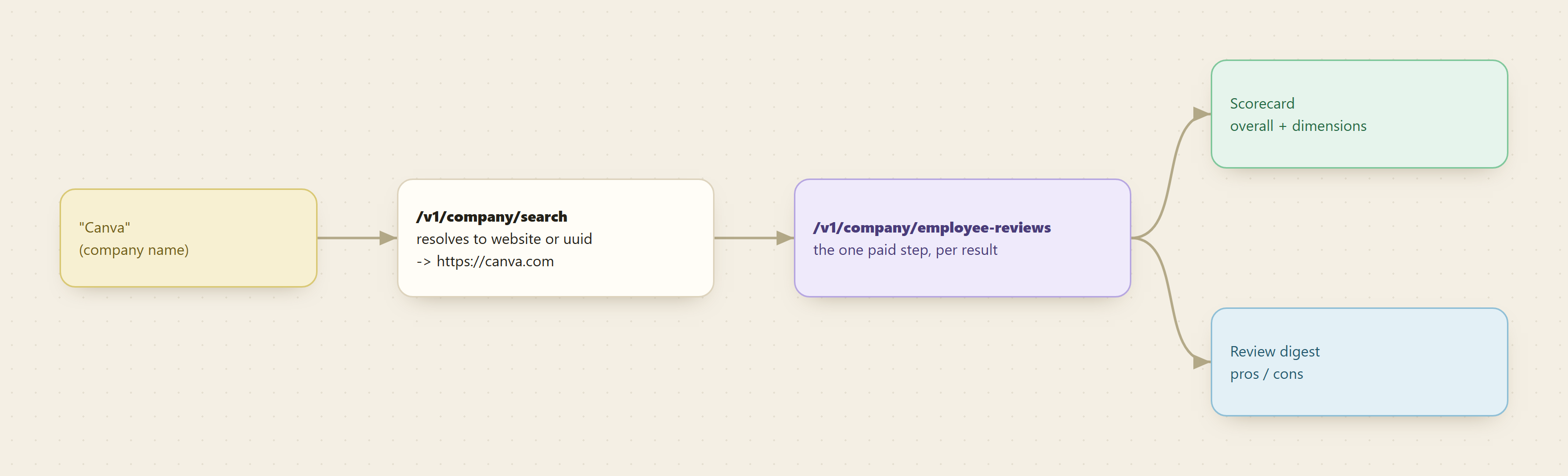
A bare company name is not enough to fetch employer reviews, but two metered Akta calls turn any name into a full ratings feed with pros, cons, and eight dimension scores.
set up https://monid.ai/SKILL.md and use akta to turn a company name into an employer review feed
Both Akta endpoints in this recipe live on Monid, the OpenRouter for agent tools where one integration and one balance reach over a thousand tools, so you never sign a separate Akta contract or manage a second key.
TL;DR
- The reviews come from
aktaendpoint/v1/company/employee-reviews, but that endpoint wants a company website or an Akta uuid, not a bare name, so you resolve the name first throughakta/v1/company/search. - Discover and inspect are free. Only
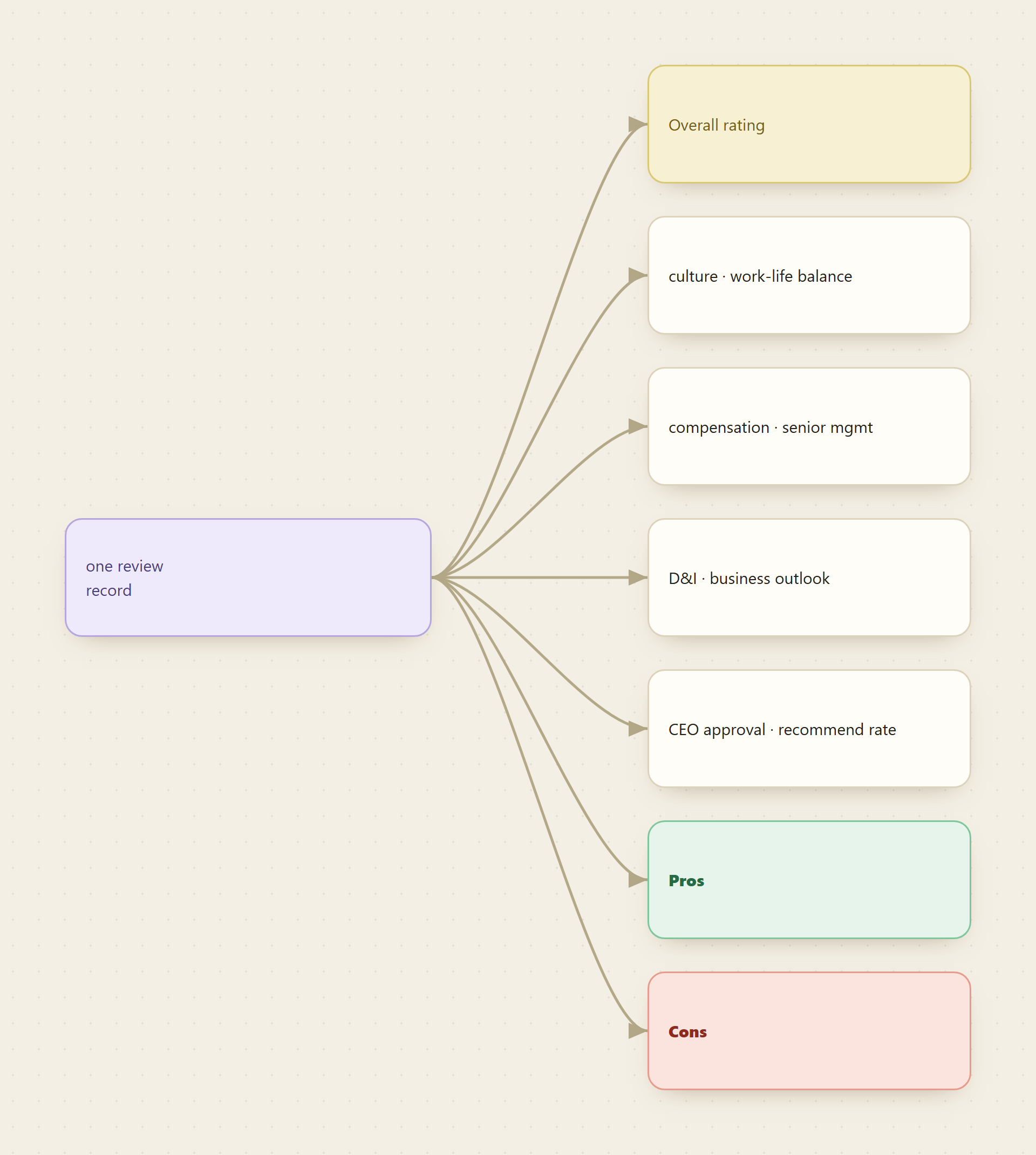
runcosts money, and/v1/company/employee-reviewsbills per result, a fraction of a cent per review returned. Check the live number at monid.ai/tools. - One call returns an overall rating plus eight dimension scores (culture, work-life balance, compensation, senior management, diversity and inclusion, business outlook, CEO approval, recommendation rate).
- The same call returns a paginated list of individual reviews with pros, cons, reviewer metadata, and per-dimension ratings, sourced from Glassdoor and other providers.
- Loop the
offsetparam to page deeper, or fan the recipe across a competitor list to build a side-by-side employer comparison feed.
Set up Monid once
For agents
Grab an API key at app.monid.ai, then paste this to your agent and hand it the key:
set up https://monid.ai/SKILL.md
It learns the whole discover, inspect, run workflow itself. More details in the agent quickstart.
For humans
npm install -g @monid-ai/cli
monid keys add --label main --key <your-api-key>
More details in the CLI quickstart.
📖 See also who should hold the copy of your B2B data
Step 1: Inspect both endpoints (free)
Inspection reads the schema without spending anything, so you can confirm the input shape of each endpoint before you commit a paid run.
monid inspect -p akta -e /v1/company/search
monid inspect -p akta -e /v1/company/employee-reviews
The search endpoint takes a plain text query (the company name you are starting from) and returns candidate companies, each carrying a website and an Akta uuid. The reviews endpoint is a query-param endpoint: it accepts company (a company website like https://canva.com or the Akta uuid), limit (default 10, max 100), and offset for pagination. Note that company will not accept a bare name like Canva, which is exactly why Step 2 exists.
Step 2: Resolve the name to a website or uuid
The reviews endpoint needs an identifier it recognizes. Send the human-friendly name through search and let Akta hand you the canonical website or uuid.
monid run -p akta -e /v1/company/search -i '{"query":"Canva"}' -w
This is a body endpoint, so the input goes in with -i, and -w waits for the result. Pick the matching candidate from the response and grab its website (for example https://canva.com) or its Akta uuid. That value is the key that unlocks the reviews feed.
Step 3: Pull the employer review feed
Now run the paid call. Because /v1/company/employee-reviews reads its inputs from query params, you pass them with --query, not -i.
monid run -p akta -e /v1/company/employee-reviews \
  --query '{"company":"https://canva.com","limit":50}' -w -o reviews.json
The -w flag waits for completion and -o reviews.json writes the full payload to disk. You now hold the aggregated signals (overall rating and the eight dimension scores) plus up to fifty individual reviews, each with pros, cons, reviewer metadata, and per-dimension ratings.
Step 4: Transform into a scorecard and a digest
With the raw JSON on disk, jq turns it into two readable artifacts. First, a one-line scorecard from the eight aggregated dimensions:
jq -r '.aggregate | "Overall \(.overall) | culture \(.culture) | wlb \(.work_life_balance) | comp \(.compensation) | mgmt \(.senior_management) | d&i \(.diversity_inclusion) | outlook \(.business_outlook) | ceo \(.ceo_approval) | rec \(.recommend_rate)"' reviews.json
Then a pros and cons digest from the individual reviews:
jq -r '.reviews[] | "PRO: \(.pros)\nCON: \(.cons)\n---"' reviews.json
The first command gives you a company at a glance. The second gives you the qualitative texture (what people actually praise and complain about) that a single rating number hides.
📖 See also Business Entity Search by API
Step 5: Page deeper or build a comparison feed
To read past the first page, hold limit steady and step offset forward:
monid run -p akta -e /v1/company/employee-reviews \
  --query '{"company":"https://canva.com","limit":50,"offset":50}' -w -o reviews_page2.json
To build a competitor comparison feed, loop the whole recipe across a list of names. Resolve each name in Step 2, run the reviews call in Step 3, and stack the scorecards from Step 4 into one table. The result is a live employer benchmarking feed you own, refreshed whenever you rerun it.
Cost tally
Inspecting both endpoints: free. Resolving the name through /v1/company/search: a small metered call. The one call that produces the feed, /v1/company/employee-reviews, bills per result, a fraction of a cent per review returned, so a fifty-review pull is fifty small units of a cent, and paging deeper simply adds more of the same. No subscription, no seat license, no annual minimum. The live per-result number is on monid.ai/tools.
FAQ
Why can't I pass the company name straight to the reviews endpoint?
Because /v1/company/employee-reviews keys on a canonical identifier (a company website or an Akta uuid), not free text. A bare name like Canva is ambiguous, so you resolve it once through /v1/company/search and then the reviews endpoint knows exactly which company you mean.
Is this a real Glassdoor API alternative? Yes. The employer reviews are sourced from Glassdoor and other providers, and you get the overall rating, the eight dimension scores, and individual reviews with pros and cons, all through one metered Akta call instead of a scraper or a locked-down official API.
How do I page through more than one hundred reviews?limit maxes out at 100 per call, so step the offset param forward in increments of your limit (0, 50, 100, and so on) and concatenate the pages. Each page is its own metered run billed per result.
Can I compare several companies in one feed? Run the two-step recipe once per company and stack the Step 4 scorecards into a single table. Since each run is independent and metered per result, a five-company comparison is just five small runs.
Try it
Point your agent at the skill file, hand it a company name, and let it resolve, run, and hand back a scorecard plus a pros and cons digest. Add a competitor list and the same recipe becomes a live employer benchmarking feed. Start at monid.ai.