Free YouTube Transcript Hacks vs a Reliable API
A buyer's comparison of every way to get transcripts in 2026: free hacks vs a metered youtube transcript api that also returns metadata.
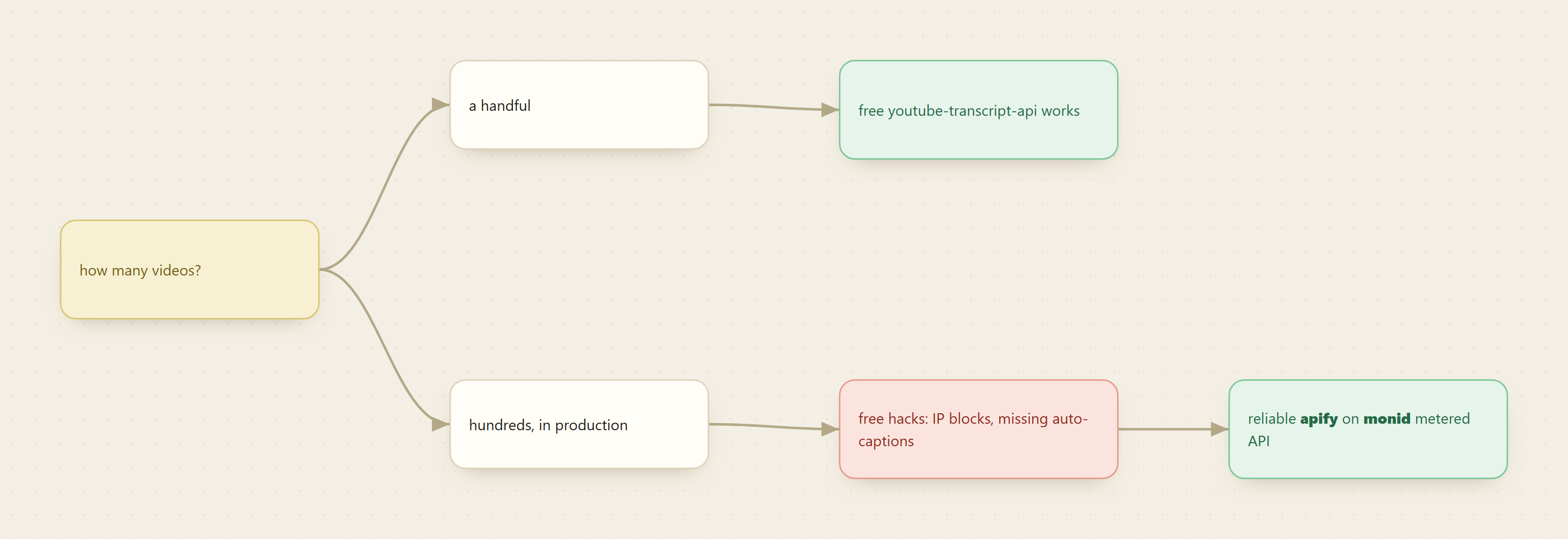
For a handful of videos, the free hacks win: the youtube-transcript-api Python library pulls a transcript in three lines and paying for that would be silly. The free tools break at exactly one predictable moment, when you scale from a few videos to a few hundred in production, because that is when IP blocks, missing auto-captions, and absent metadata stop being edge cases and start being your whole afternoon.
This is a buyer's guide, not a sales pitch. We will be fair to the free options, because they are genuinely good, and then show where a metered API earns its keep.
TL;DR
- Under ~10 videos, one-off: use the free youtube-transcript-api library. Trivial, free, correct.
- A robust download tool: yt-dlp
--write-auto-subis bulletproof at fetching, but you parse the VTT yourself and get no engagement metadata. - At scale or in production: the free routes hit IP rate limits, silently fail when only auto-captions exist, and never return view or subscriber counts.
- When you need the metadata in the same call: a metered scraper API (Apify
/starvibe/youtube-video-transcripton Monid) returns a timestamped transcript plus video and channel metadata, with auto-caption fallback, billed per result. - Cost for the API is a fraction of a cent territory per result and nothing is pre-committed. See monid.ai/tools.
What actually breaks when you scale the free hacks?
Each free option is the right tool inside its range. Here is the honest failure mode of each.
The youtube-transcript-api library. For one video it is close to perfect. YouTubeTranscriptApi.get_transcript(video_id) returns a list of {text, start, duration} segments and you are done. The problems appear only under load. YouTube rate-limits by IP, so a loop over a few hundred IDs from one server starts returning IpBlocked or TooManyRequests errors, and cloud provider IP ranges get blocked faster than residential ones. It also assumes a manual transcript exists. When a creator only has auto-generated captions, or captions in another language, you have to branch through list_transcripts() and handle the fallback yourself. And it returns zero metadata: no title, no view count, no publish date. You get text, nothing else.
yt-dlp --write-auto-sub. yt-dlp is the most robust fetcher of the three because it maintains its extractor against YouTube changes constantly. The catch is that it hands you a .vtt subtitle file on disk, not clean data. You now own VTT parsing: stripping timestamp cue headers, de-duplicating the rolling-window lines that auto-captions repeat, and stitching fragments into sentences. It is still throttled at volume, and like the library it gives you captions but no engagement metadata. Great for archiving, more work for a data pipeline.
DIY timedtext scraping. Some teams skip both tools and hit the internal timedtext caption endpoint directly, sometimes after parsing the player response for the caption track URL. It is fast and it works until it does not. That endpoint is undocumented, the signature and parameter scheme change without notice, and when Google ships a tweak your scraper returns empty strings on a Tuesday with no error. You are maintaining a reverse-engineered dependency forever.
The pattern across all three: they are cheap and correct at small N, and they fail on volume, on auto-caption fallback, and on metadata. Those are precisely the three things a production job needs.
📖 See also the hundred-search-a-day ceiling
The comparison table
| Option | Cost | Holds up at scale? | Metadata included? | Best for |
|---|---|---|---|---|
| youtube-transcript-api | free | No: IP-blocked, rate-limited | No | 1 to 10 videos, research scripts |
| yt-dlp --write-auto-sub | free | Partly: robust fetch, still throttled, you parse VTT | No | Archiving, offline caption files |
| DIY timedtext scraping | free | No: breaks when Google changes it | No | Nothing we would ship |
| Apify transcript API on Monid | fraction of a cent per result | Yes: managed, metered | Yes | Bulk, production, metadata needed |
What a reliable youtube transcript api returns
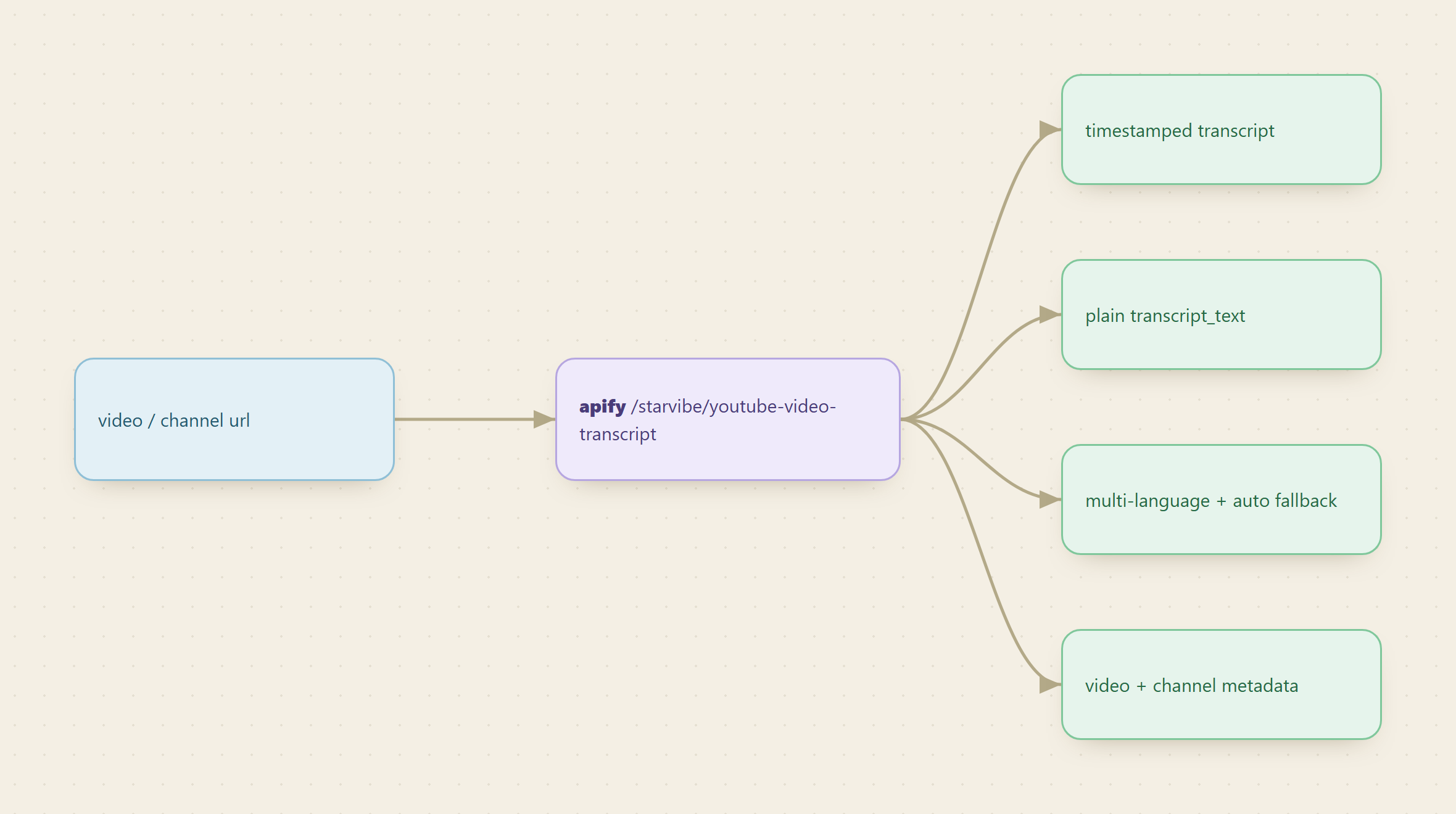
Monid is the OpenRouter for agent tools where one interface and one balance reach over a thousand tools, so you can call a maintained YouTube scraper without a per-vendor signup and pay only for results. The endpoint here is Apify's /starvibe/youtube-video-transcript, metered per result.
One call returns more than the free tools combined:
- Timestamped transcript segments, and an optional concatenated
transcript_textstring when you setinclude_transcript_textto true (handy for dropping straight into an LLM prompt). - Multi-language captions with automatic fallback to auto-generated when no manual track exists, so the failure case the library makes you code by hand is handled inside the call.
- Video and channel metadata in the same response: titles, descriptions, publish time, duration, view/like/comment counts, subscriber count, and the list of available transcript languages.
That metadata is the real reason to pay. When you are ranking 200 videos to decide which to summarize, view count and publish date are the signal. Getting them in the transcript call means you skip a second scrape entirely.
📖 See also What Is the Best API for Social Media Scraping in 2026?
How to run it
Copy this line to your agent to pull a full YouTube transcript with metadata.
set up https://monid.ai/SKILL.md and use apify /starvibe/youtube-video-transcript to fetch a video transcript plus its channel metadata
For agents
Grab an API key at app.monid.ai, then paste this to your agent and hand it the key:
set up https://monid.ai/SKILL.md
It learns the whole discover, inspect, run workflow itself. More details in the agent quickstart.
For humans
npm install -g @monid-ai/cli
monid keys add --label main --key <your-api-key>
More details in the CLI quickstart.
Inspect the endpoint to see its input schema before you spend anything (inspect is free):
monid inspect -p apify -e /starvibe/youtube-video-transcript
Run it on a single video. Provide exactly one of youtube_url or channel_url:
monid run -p apify -e /starvibe/youtube-video-transcript -i '{"youtube_url":"https://www.youtube.com/watch?v=gN07gbipMoY","language":"en","include_transcript_text":true}' -w
For a whole channel, swap to channel_url with max_videos (1 to 200) and optional start_date/end_date:
monid run -p apify -e /starvibe/youtube-video-transcript -i '{"channel_url":"https://www.youtube.com/@channelhandle","max_videos":25,"include_transcript_text":true}' -w
Billing is per result, so a channel pull of 25 videos costs 25 results worth and there is nothing pre-committed. Pricing magnitude and the full catalog live at monid.ai and monid.ai/tools.
The honest caveat
If your job is a research notebook, or you touch fewer than a dozen videos, install the free library and move on. Paying per result to summarize five talks you watched last week is wasteful, and we will tell you that. The API is not a better tool for one video. It is a better tool for two hundred videos, for a scheduled pipeline that cannot babysit IP blocks, and for any case where you need engagement metadata and auto-caption fallback in the same response. Match the tool to the N.
FAQ
Is there a free YouTube transcript API? The youtube-transcript-api Python library is free and open source, and for a small number of videos it is the right choice. It is a library you run yourself, not a hosted service, so at volume you inherit IP rate limits and metadata gaps.
Why do free transcript scrapers get blocked?
YouTube rate-limits caption requests by IP address. A loop from a single server, especially a cloud IP, trips those limits quickly. A managed API spreads and maintains the fetching so your job does not stall on TooManyRequests.
What does the Apify endpoint return that the library does not?
Video and channel metadata (view, like, comment, and subscriber counts, publish time, duration), multi-language captions with automatic fallback to auto-generated, and an optional concatenated transcript_text, all in one call.
Can I pull an entire channel at once?
Yes. Use channel_url with max_videos from 1 to 200 and optional start_date/end_date. Each returned video is billed as one result.