MiniMax vs Seedance: AI Video Generation API in 2026
MiniMax Hailuo-2.3 bills flat per clip for silent b-roll; Seedance adds synchronized audio and 4K at a per-token price. Compare and A/B both on one balance.
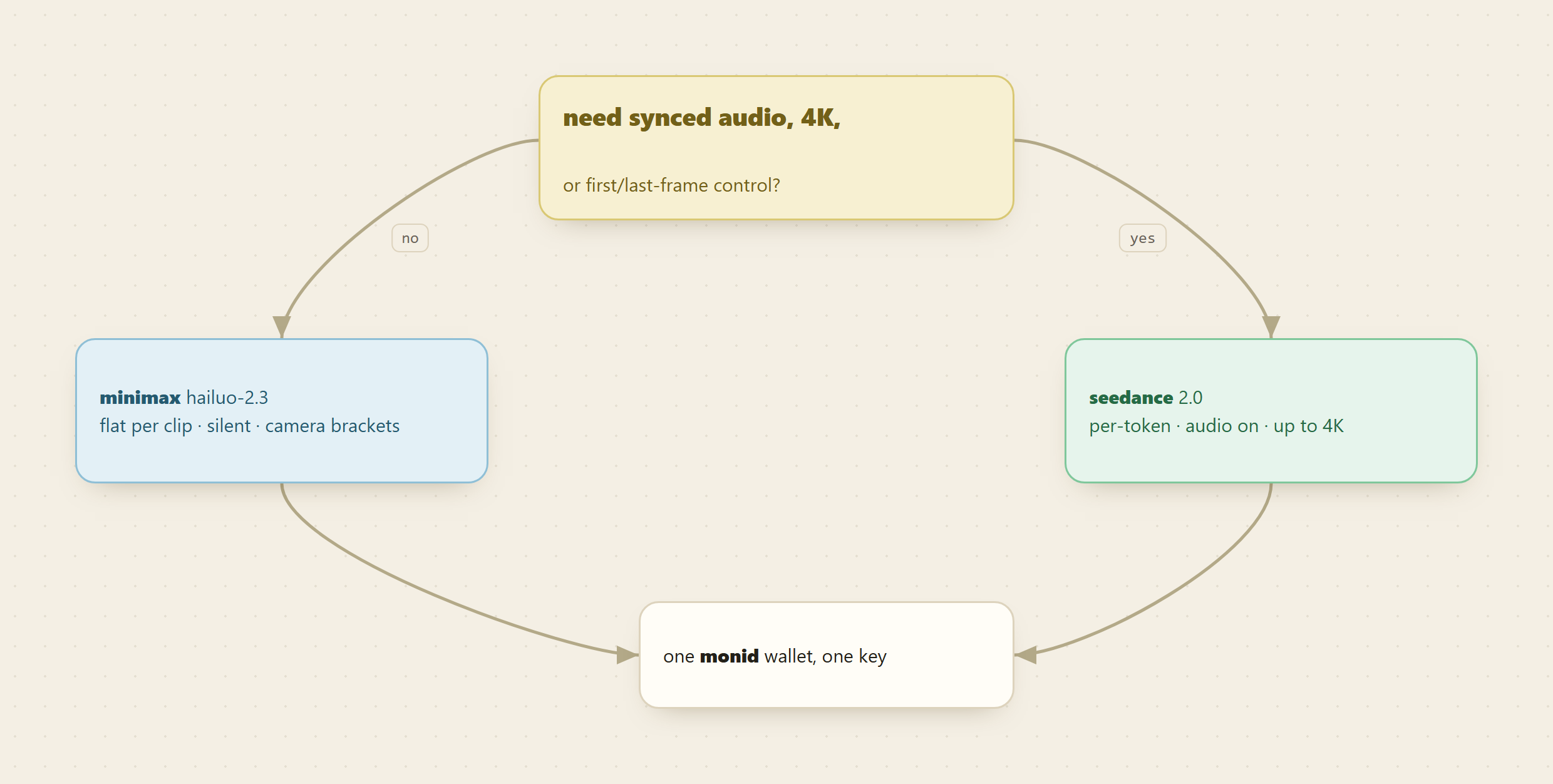
MiniMax Hailuo-2.3 and ByteDance Seedance are not competing for the same job, so the useful question is not "which is better" but "which one fits this clip." Pick MiniMax when you want a flat, predictable price per clip and simple prompt-or-image-to-video with camera control. Pick Seedance when you need synchronized audio, higher resolution, or reference-driven control like first-and-last-frame pinning, and you accept a bill that scales with pixels and seconds. The reason you can actually test that claim on your own footage instead of taking our word: both models run on one Monid wallet, so you A/B them without signing two vendor contracts.
TL;DR
- MiniMax
/v1/video_generation(model MiniMax-Hailuo-2.3) does text-to-video and image-to-video with camera commands in bracket syntax like[Push in]. It bills flat per call by resolution and duration, so the same clip length costs the same no matter the content. - Seedance
/v1/video/seedance-2.0-minitakes acontentarray mixing text, images, reference video, and reference audio. It ships synchronized voice, sound effects, and music by default, up to 4K on the full tier, and bills per token, so cost scales with resolution and length. - Predictable, silent, budgeted batch b-roll leans MiniMax. Sound, 4K, or reference control leans Seedance.
- Both sit behind one pay-as-you-go key, so the choice is per clip, not per contract. Cost magnitudes are on monid.ai/tools.
- Both return a download link that expires, so pipe the download step right after the run.
Monid is the OpenRouter for agent tools that reaches over a thousand tools from one key and one balance, and you pay only when a run succeeds. That is what makes an honest head-to-head cheap: two runs, two invoices, same prompt, no second signup.
What each model is built for
MiniMax Hailuo-2.3 is a focused text-or-image-to-video generator. You hand it a prompt, or a first_frame_image as a public URL or base64 still, and steer the shot with bracketed camera moves: [Push in], [Truck left], [Zoom out]. Resolution is 768P at 6 or 10 seconds, or 1080P at 6 seconds only. prompt_optimizer is on by default. It does not advertise synchronized audio, so treat the output as silent b-roll you will score later. The design goal is a clean, cheap, repeatable clip where you always know the price before you press go.
Seedance 2.0 is a broader control surface. The body is a content array that can mix text, image_url items with roles first_frame, last_frame, or reference_image (one to nine of them), a video_url reference for editing and extension, and an audio_url reference. That unlocks text-to-video, image-to-video, first-and-last-frame pinning, and reference-to-video. generate_audio defaults to true, so a plain prompt comes back with voice, sound effects, and music already synced. Resolution runs 480p and 720p on the mini tier and up to 4K on the full 2.0 tier, duration spans 4 to 15 seconds, and ratio includes 9:16 for shorts. You buy range and fidelity, and you pay per token for it. Endpoint details live in the BytePlus ModelArk docs.
MiniMax vs Seedance at a glance
| Axis | MiniMax Hailuo-2.3 | Seedance 2.0 |
|---|---|---|
| Inputs | Prompt, or single first_frame_image (URL or base64) | content array: text, 1 to 9 images, reference video, reference audio |
| Camera / reference control | Bracket camera commands ([Push in], [Truck left]) | First / last frame pinning, reference image, reference video, reference audio |
| Native audio | Not advertised (treat as silent) | Synchronized voice, SFX, and music on by default |
| Max resolution | 1080P (6s only) | Up to 4K on full 2.0 |
| Duration options | 768P at 6s or 10s, 1080P at 6s | 4 to 15 seconds |
| Pricing shape | Flat per clip by resolution and duration | Per token (roughly width x height x 24fps x seconds / 1024) |
| Predictability | Same length is the same price regardless of content | Cost scales with pixels and seconds, less flat |
| Best fit | Predictable silent b-roll, batch variations | Sound, 4K, reference-driven edits and extensions |
Set up once, then run either model
Discovery and inspection are free on Monid. monid discover -q "..." finds endpoints and monid inspect -p <provider> -e <endpoint> shows the schema and the live price. Only monid run bills, and only on success. Set up the key once, then both providers answer to the same CLI.
For agents
Grab an API key at app.monid.ai, then paste this to your agent and hand it the key:
set up https://monid.ai/SKILL.md
It learns the whole discover, inspect, run workflow itself. More details in the agent quickstart.
For humans
npm install -g @monid-ai/cli
monid keys add --label main --key <your-api-key>
More details in the CLI quickstart.
With the key in place, the same barista shot runs through both models. The -w flag waits inline and prints the result when the job lands:
# MiniMax Hailuo-2.3: flat price per clip, camera bracket syntax
monid run -p minimax -e /v1/video_generation \
  -i '{"prompt":"A barista finishes a latte-art pour, macro, soft morning light. [Push in]","resolution":"768P","duration":6}' -w

# ByteDance Seedance 2.0 Mini: per-token, synchronized audio on by default
monid run -p bytedance -e /v1/video/seedance-2.0-mini \
  -i '{"content":[{"type":"text","text":"A barista finishes a latte-art pour, macro, soft morning light."}],"resolution":"720p","duration":5,"ratio":"9:16"}' -w
The MiniMax run returns a download_url for a silent clip with the camera push baked in, exactly as priced. The Seedance run returns a video_url for a clip that already has ambient cafe sound and a soft musical bed, at a token count you can read back in the usage. Look at both, then decide per surface. The full input shape for the MiniMax side is in the MiniMax video generation reference.
What a clip actually costs
Here is the per-clip reasoning, because the pricing shapes are genuinely different and that difference is the whole story.
MiniMax bills flat per call by resolution and duration. A 768P 6-second clip costs the same whether it is an empty room or a crowded market, and a second render of the same length costs the same again. That makes batch budgeting trivial: multiply your flat per-clip magnitude, a fraction of a cent to single-digit cents depending on the tier, by the number of clips, and you have your bill before you start. There are no content-driven surprises.
Seedance bills per token, where tokens are roughly width times height times 24fps times seconds divided by 1024. A 720p 16:9 second is about 21,600 tokens, so cost climbs with both resolution and length. A 5-second 720p vertical clip is cheap in absolute terms, but push to 4K or to 15 seconds and the token count, and the bill, rises with the pixels you asked for. You are paying for the audio track, the resolution ceiling, and the reference control, and the meter reflects that.
The clean heuristic: for a wall of predictable silent b-roll where you know exactly what the batch will cost, MiniMax wins on budgeting. For anything where the audio, the 4K, or the reference control is the point, Seedance earns its variable price. Live magnitudes for both are on monid.ai/tools.
📖 See also when pay per call beats a plan
One honest caveat
Seedance is the more capable model, but that capability comes with a real constraint worth knowing before your first run: reference URLs must be public https:// links or asset ids, not inline base64, and reference images or videos containing real human faces are rejected upstream. So if your workflow is "animate this photo of my founder," Seedance will refuse the face, and MiniMax image-to-video with a non-face still may be the practical path instead. Neither model is a full substitute for the other, which is exactly why running both from one balance beats betting a pipeline on one before you have tested it.
Which do I pick?
Silent, budgeted, predictable batch b-roll goes to MiniMax: the flat per-clip price and the bracket camera moves give you a spreadsheet-friendly cost and a clean silent plate to score yourself. Anything that needs sound out of the box, 4K, or reference control like first-and-last-frame pinning or video extension goes to Seedance, and you accept a per-token bill that tracks the pixels and seconds you requested. And because both links expire (MiniMax's download_url and Seedance's video_url, the latter in about 24 hours), pipe the download step immediately after the run rather than treating either link as storage.
FAQ
Which is cheaper, MiniMax or Seedance? It depends on the clip. MiniMax bills flat per call, so a fixed-length clip is a known, content-independent price, ideal for predictable batches. Seedance bills per token, so a short 720p clip is inexpensive but 4K or long durations cost more. Compare live magnitudes at monid.ai/tools.
Does MiniMax generate audio like Seedance does?
No. MiniMax Hailuo-2.3 does not advertise synchronized audio, so treat its output as silent b-roll and add sound in post. Seedance sets generate_audio to true by default and returns voice, sound effects, and music synced to the video.
Can I animate a photo of a real person?
With MiniMax you can pass a non-face still as first_frame_image. Seedance rejects reference images and videos containing real human faces upstream, and its reference URLs must be public https:// links or asset ids, not inline base64. Choose the model that matches your source material.
Do I need two accounts to test both? No. Both MiniMax and ByteDance Seedance are reachable from one Monid key and wallet. Grab a key at app.monid.ai, inspect each endpoint for free to read the live price, and run the same prompt through both before you commit a pipeline.