The Real Cost of Phone Validation at Scale
Standing subscription validators vs pay-per-call phone validation on Monid, compared on cost shape, line-type coverage, and when each one wins.
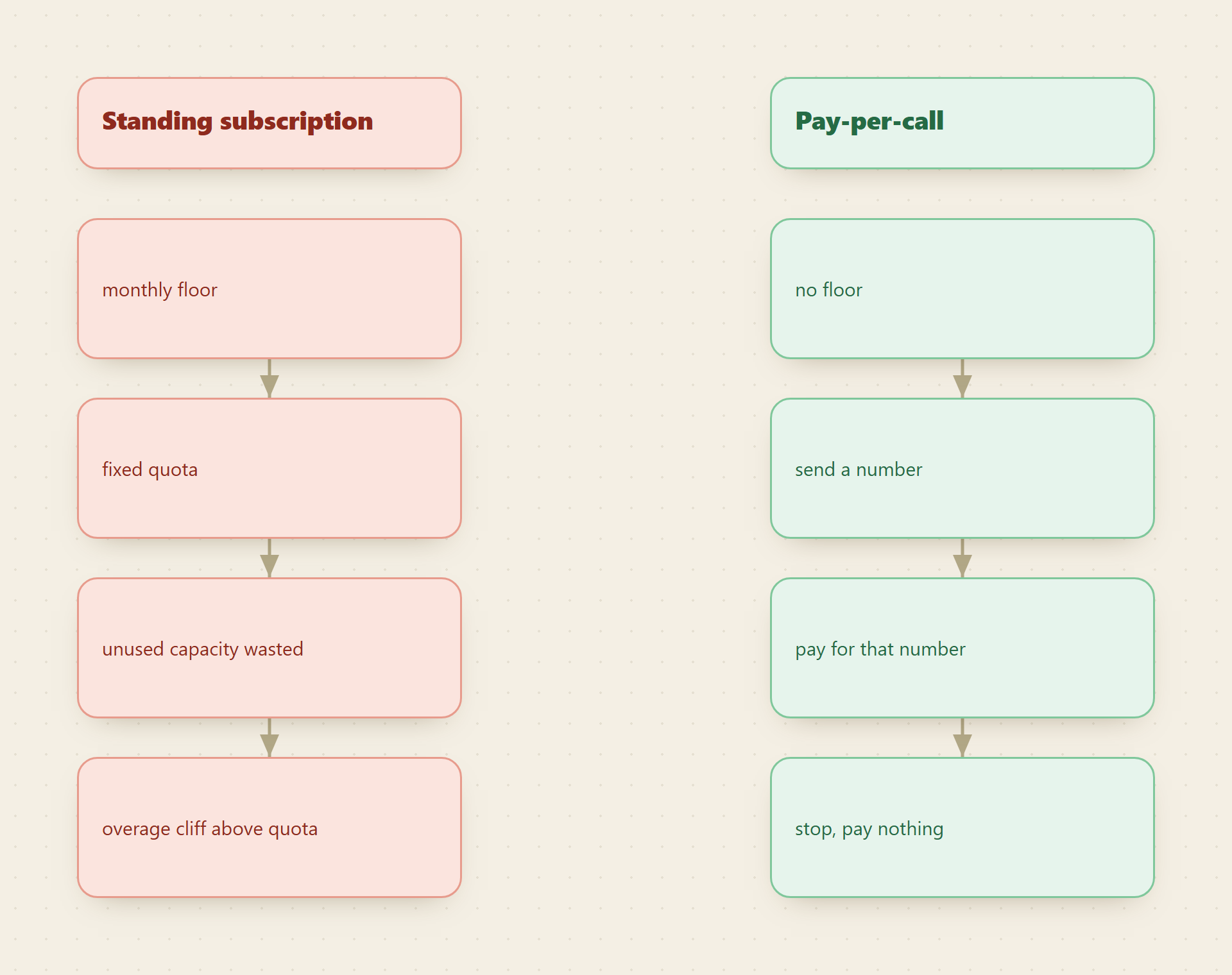
The cheaper phone validator is not the one with the lower advertised rate. It is the one whose cost shape matches how your numbers actually arrive. A standing subscription validator like Twilio Lookup or a monthly-quota tool like NumVerify charges you to hold capacity you may not use. A pay-per-call validate on Monid charges only for the numbers you send, at a price you read before you send them. On a steady, high-volume feed the subscription can win. On a spiky or unpredictable one, the metered call almost always does.
Copy this line to your agent to price a phone-validation job before you commit to a plan.
set up https://monid.ai/SKILL.md and use strale phone-validate to classify a batch of numbers and price it per call
TL;DR
- The decision is cost shape, not sticker rate. A subscription bills a monthly floor plus overages whether you use the quota or not. A pay-per-call validate bills only for numbers actually sent, with no floor.
- One Strale
phone-validatecall returns the whole verdict: validity, E.164 normalization, country, carrier name, and a line-type classification (mobile, landline, or VOIP) across 200+ countries. - Line type is the field that matters most. A number can be syntactically valid and still be a VOIP throwaway, which is exactly what you want to catch before an SMS spend or a dialer campaign.
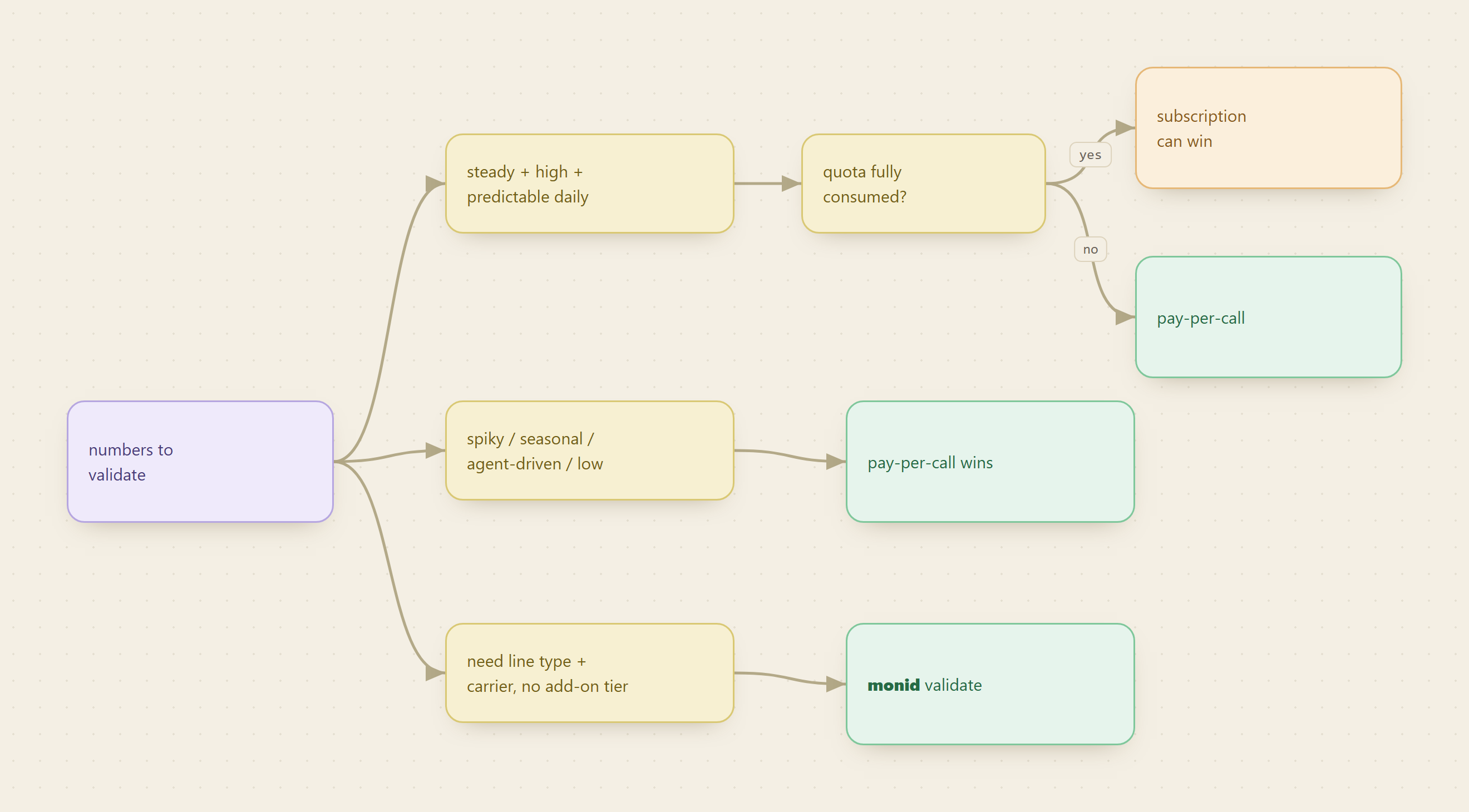
- Subscriptions win on steady, predictable, high-daily-volume feeds where the quota is fully consumed every month. Pay-per-call wins on spiky, seasonal, agent-driven, or unpredictable volume.
- Monid is the OpenRouter for agent tools: one interface and one balance to discover, inspect, and run over a thousand tools without a separate signup per vendor, priced per call at the number shown before you run. Magnitudes are at monid.ai/tools.
The two cost shapes, and why they decide the invoice
Every validator publishes a per-lookup number and lets you assume that is what you pay. What you actually pay is that number divided by how much of your committed capacity you use.
A subscription validator asks you to size a plan in advance. You pick a monthly tier, that tier comes with a request quota, and you pay the tier whether you hit the quota or not. Go over, and overage rates kick in, often higher than the in-plan unit price. NumVerify's plans are structured exactly this way, with a fixed monthly request allowance per tier documented on its pricing page. The unused half of a quota is money you spent on capacity you did not need. Twilio Lookup is per-lookup rather than quota-based, but the richer signals sit behind separate line-type-intelligence and carrier packages, priced per data package, and the whole thing lives inside a Twilio account you provision and maintain as a standing relationship.
A pay-per-call validate has no floor to size and no quota to guess. You send a number, you pay for that number, you stop, you pay nothing. On Monid the /x402/phone-validate endpoint bills per call at a rate a free monid inspect prints before a single cent moves. There is no plan to right-size and no overage cliff, because there is no plan at all.
📖 See also ZeroBounce, NeverBounce and the alternatives
What a single call returns, and which fields matter
Validation is only worth paying for if the returned fields let you make a decision. Strale's phone-validate returns the full assessment in one response: whether the number is valid, its E.164-normalized form, the country it belongs to, the carrier name, and a line-type classification of mobile, landline, or VOIP, with coverage across 200+ countries.
The field that earns its keep is line type. A number can pass a syntax and format check and still be a VOIP line spun up for a throwaway account, or a landline where your SMS will silently vanish. If you are about to spend on an SMS blast, seed a dialer, or gate a signup on a phone, the mobile-versus-VOIP-versus-landline split is the signal that stops the waste. E.164 normalization is the second quiet win: it turns (415) 555-2671, +1 415 555 2671, and 0041415552671 into one canonical string so your dedupe and your downstream systems agree on what a number is. Carrier and country round out routing and compliance decisions.
Set up once
For agents
Grab an API key at app.monid.ai, then paste this to your agent and hand it the key:
set up https://monid.ai/SKILL.md
It learns the whole discover, inspect, run workflow itself. More details in the agent quickstart.
For humans
npm install -g @monid-ai/cli
monid keys add --label main --key <your-api-key>
More details in the CLI quickstart.
Running the validate
Inspect the schema and the exact price for free, then run one number. phone-validate takes query params, so pass them with --query:
monid inspect -p api.strale.io -e /x402/phone-validate      # schema + price (free)

monid run -p api.strale.io -e /x402/phone-validate \
  --query '{"phone_number":"+14155552671","country_code":"US"}' -w
# -> validity, E.164, country, carrier, line type (mobile / landline / VOIP)
#    billed per call, price shown before it ran
phone_number is required and accepts any format. country_code is an optional ISO-2 hint that helps resolve ambiguous or locally formatted numbers. The -w flag waits inline and hands the verdict straight back, which is what a form handler or an agent step wants.
When each one wins
Neither shape is better in the abstract. They are built for different volume patterns.
| Standing subscription (Twilio Lookup / NumVerify style) | Pay-per-call on Monid (Strale phone-validate) | |
|---|---|---|
| Cost shape | Monthly floor and/or quota; overage above it | Per call, no floor, no quota |
| Commit | Plan sized in advance, standing account | Nothing pre-committed, shared balance |
| Break-even | Wins when the quota is fully consumed every month | Wins on spiky, low, or unpredictable volume |
| Line type + carrier | Often a separate add-on tier or package | Included in the single call |
| Best-fit volume | Steady, high, predictable daily feed | Seasonal, bursty, agent-driven, or small |
| Coverage | Strong, mature global data | Validity, E.164, country, carrier, line type across 200+ countries |
The routing rule is simple. If you validate a large, steady stream every single day and you will genuinely consume the quota month after month, a subscription's committed unit price can edge out per-call, and a mature vendor's global coverage is worth the standing relationship. If your volume is bursty, seasonal, driven by an agent that validates numbers only when it encounters them, or just small, the pay-per-call shape stops you from renting capacity you do not use. And if you need line type and carrier without climbing an add-on tier, the single Strale call hands you both.
📖 See also the pay-per-call pricing breakdown
Per-number cost, reasoned in magnitudes
We do not print rates here, because the honest unit is cost per validated number and the shape decides it. A free monid inspect prints the exact per-call price before you run, and a free monid discover -q "phone validation" ranks the options with provider and price. Live magnitudes are at monid.ai/tools. The reasoning that survives any price change:
- A subscription's real unit cost is the plan price divided by the calls you actually made, not the calls the plan allowed. Consume half the quota and your true per-number cost doubles.
- Pay-per-call holds its number at any volume. Validate ten numbers or ten thousand, and each one costs what
inspectshowed. There is no floor to amortize and no overage to fear. - An agent that validates a few dozen to a few hundred numbers a day, at a fraction of a cent to a few cents per call, is a single-digit-dollar habit with nothing pre-bought. Every one of those charges was visible before it ran.
Because the validate draws from the same pay-as-you-go balance as your scraping and enrichment, it is a line item, not a second vendor to reconcile. The dollar you did not spend on phone checks is still there for the next lookup.
One honest caveat
Coverage and carrier freshness vary by country. A mature standing vendor has spent years building global carrier data, and on some regions and some carrier edge cases its line-type accuracy may be a step ahead. Do not take a table's word over your own numbers. Take a hundred numbers where you already know the truth, run them through the endpoint, and check the line-type and carrier calls against reality before you wire it into anything that spends money on the result. The cost-shape argument only matters once the accuracy clears your bar, so measure that first, then let volume pattern pick the shape.
FAQ
Which is cheaper for phone validation, a subscription or pay-per-call? It depends on your volume pattern, not the advertised rate. A subscription wins only when you fully consume its quota every month. On spiky, seasonal, or unpredictable volume, pay-per-call is cheaper because it has no floor and no wasted quota. Magnitudes are at monid.ai/tools.
What does one phone-validate call actually return?
Validity, the E.164-normalized number, country, carrier name, and a line-type classification of mobile, landline, or VOIP, across 200+ countries, all in a single response.
Why does line type matter more than a syntax check? Because a number can be perfectly valid and still be a VOIP throwaway or a landline where SMS disappears. Line type is the signal that stops you spending on unreachable or fake numbers before an SMS or dialer campaign.
Do I need a standing account to try it? No. Grab a key at app.monid.ai, and the validate draws from the same pay-as-you-go balance as everything else on Monid, billed per call at the price shown before you run.
Try it
Take a hundred numbers you know the answer for, run a free monid discover for phone validation, inspect /x402/phone-validate to see its schema and price, and validate them. If the line-type and carrier calls match reality, let your volume pattern pick the shape and let one balance cover it. Start at monid.ai.