ZeroBounce, NeverBounce, or One Call on Monid?
Email verification API in 2026: ZeroBounce and NeverBounce credit packs vs one metered Strale email-validate call on Monid, compared by billing and depth.
If you check emails one at a time as they arrive, a single metered Strale email-validate call on Monid beats any credit pack. If you are scrubbing a bought list of 50,000 addresses once, a dedicated verifier like ZeroBounce or NeverBounce is still the sharper tool. The dividing line in 2026 is billing shape and verification depth, not brand loyalty.
TL;DR
- Dedicated verifiers sell credit packs or subscriptions. Unused credits expire, and you pre-buy before you know your volume.
- They earn that price with live SMTP mailbox pinging, catch-all detection, and a bulk-list dashboard that matters for one-off cleaning.
- A single Strale
/x402/email-validatecall on Monid is pay-per-call: syntax, MX, disposable, role-based, free-provider, typo suggestion, and a deliverability verdict, with nothing to pre-buy and nothing to strand. - Metered wins for inline per-signup checks inside an agent or signup flow. Credit-pack verifiers win for deep SMTP mailbox verification on a static list.
- Cost is a fraction of a cent per email checked, billed only when the call runs.
Monid is a pay-per-call data API marketplace where one interface and one wallet reach hundreds of external data endpoints, so you can run a single email-validate call without a per-vendor signup or a pre-bought credit balance.
Why do email verifiers sell credit packs, and what does that cost you?
Credit packs exist because live email verification is expensive to run. To confirm a mailbox truly exists, a verifier opens an SMTP conversation with the receiving server and reads how it answers a RCPT TO command. That is real infrastructure with rotating IPs and reputation to protect, so vendors amortize it by making you buy credits up front.
The catch is that you commit to a volume before you know it. ZeroBounce and NeverBounce both meter by credit, and packs carry expiry windows. If you buy 25,000 credits for a launch that only sends 6,000 emails, the remainder sits and eventually strands. Subscriptions have the mirror problem: pay monthly whether you verify one address or one million. Neither shape fits the case where emails trickle in one at a time, like a signup form, because you are pre-buying a stockpile to spend a few credits a day.
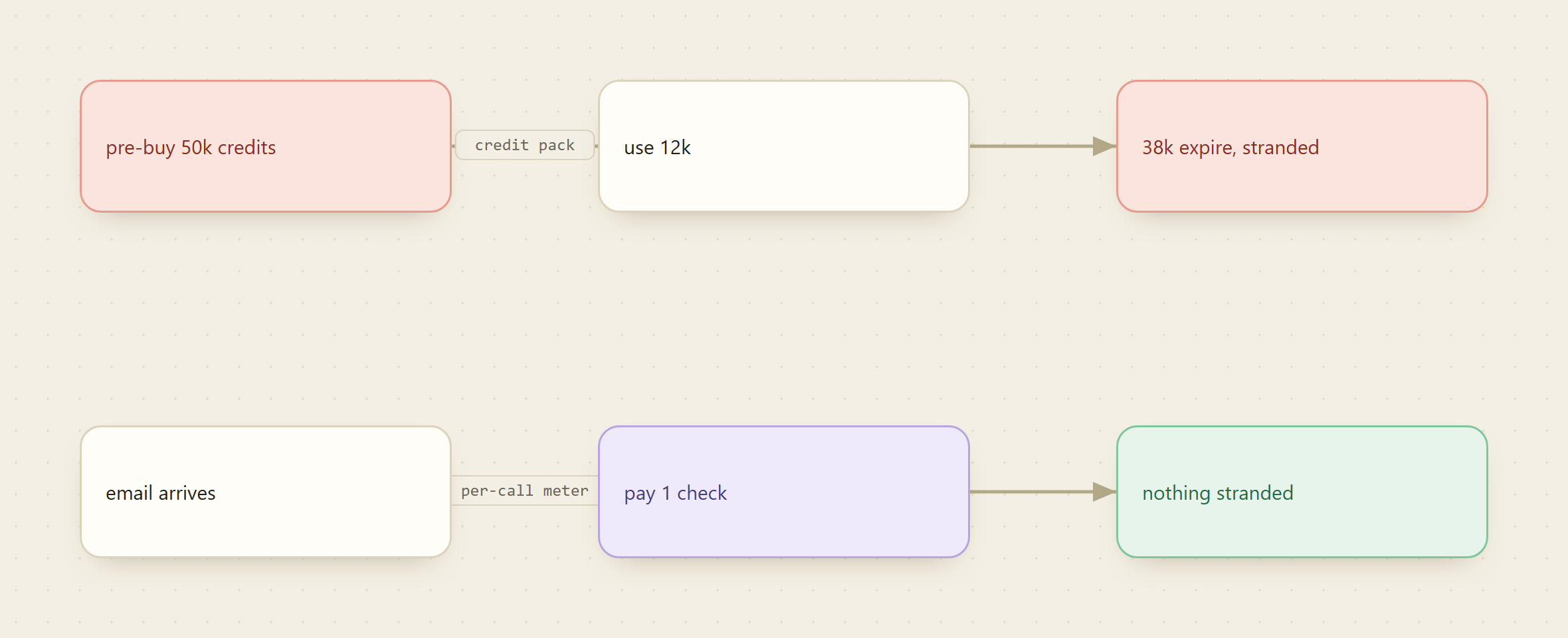
A per-call meter inverts this. You pay when an email is actually checked, and there is no balance to expire. For inline, real-time checks embedded in a flow, that shape removes the whole forecasting problem.
What does a single Strale email-validate call actually check?
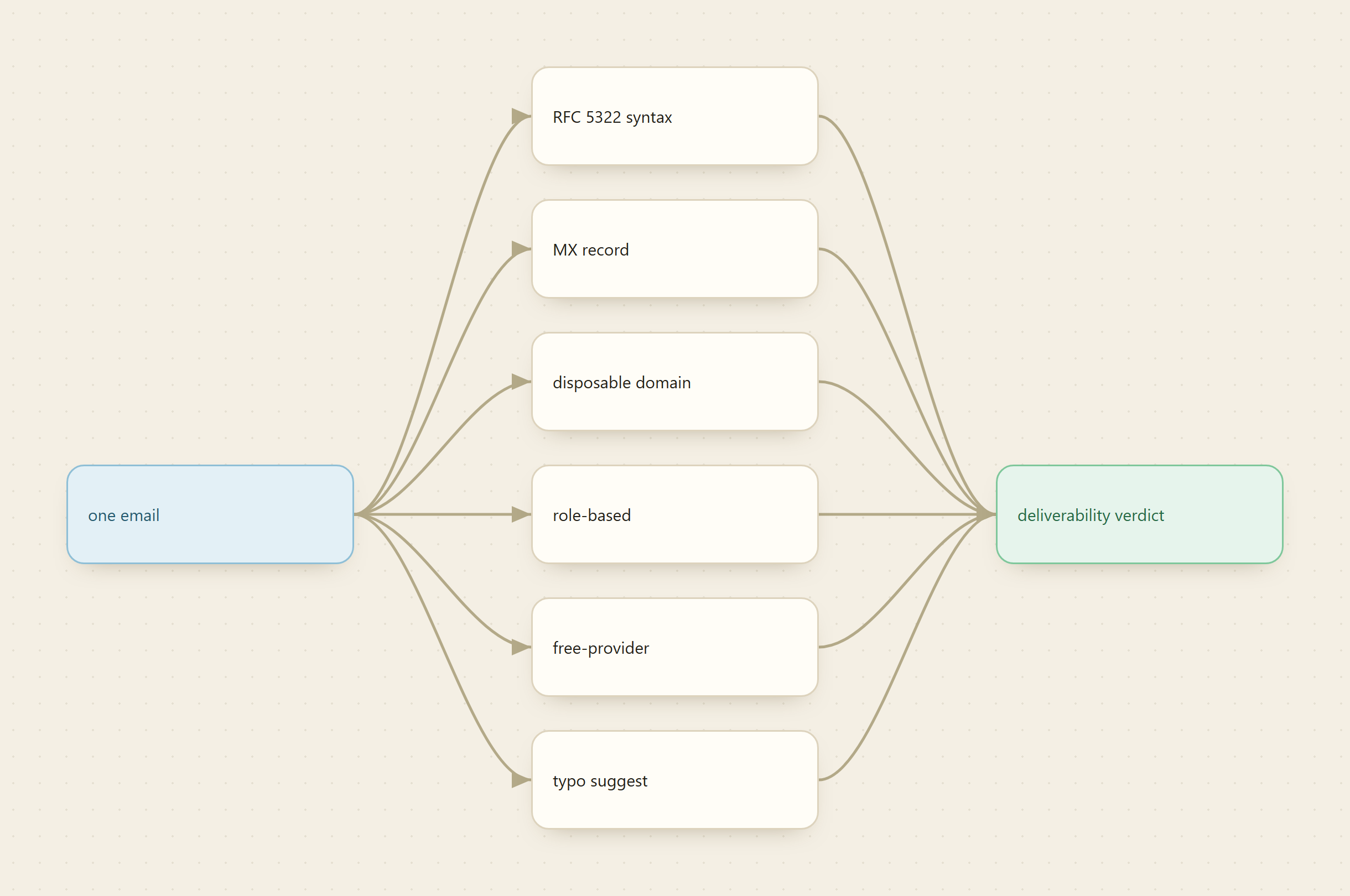
Strale's /x402/email-validate is a GET with one query parameter, email. It runs a stack of checks and returns a verdict:
- RFC 5322 syntax check: is the address even well-formed.
- MX record check: does the domain publish mail servers that can receive.
- Disposable-domain detection: matched against 5,361 known throwaway domains (mailinator and friends).
- Role-based address detection: 35 patterns like info@, sales@, admin@ that hurt inbox rates.
- Free-provider detection: flags gmail, outlook, and similar consumer domains.
- Typo suggestion: corrects gmial.com to gmail.com so you can offer a fix at the form.
- Deliverability assessment: a rolled-up verdict you can gate a signup on.
The fields you act on differ by use case. At a signup form, the typo suggestion is the highest-value output because you can show "did you mean gmail.com?" and recover a real user instead of silently dropping them. For lead lists, the disposable and role-based flags are what you filter on, since those are the addresses that never convert. The MX and syntax checks are your cheap first gate: fail either and there is no reason to spend anything deeper.
Honest caveat: this is a lightweight validate call, not a full SMTP mailbox ping. It confirms the domain can receive mail and the address is clean, but it does not open a live conversation with the mailbox the way ZeroBounce does, so it will not catch a syntactically valid address at a real domain that simply does not exist. For catch-all domains, which accept everything at the SMTP layer, no verifier is fully certain, and the deep verifiers at least try. Know which guarantee you need.
ZeroBounce vs NeverBounce vs a metered call on Monid
| Option | Verification depth | Billing shape | Expiry / waste | Best for |
|---|---|---|---|---|
| ZeroBounce | Deep: live SMTP ping, catch-all, spam-trap and abuse flags, plus a bulk-list UI | Credit packs or subscription | Credits expire, subscription bills idle months | One-off cleaning of a large bought list |
| NeverBounce | Deep: real-time SMTP verification, catch-all handling, bulk dashboard | Pay-as-you-go credits and subscription tiers | Bulk credits can strand if volume is over-bought | Bulk list validation with a dashboard workflow |
| Kickbox / Bouncer | Deep SMTP with a sendability/quality score and list UI | Credit packs | Packs expire on their own clock | Teams wanting a quality grade per address |
| Strale on Monid | Lightweight: syntax, MX, disposable, role, free-provider, typo, deliverability verdict | Metered pay-per-call | None: pay per email checked, nothing to strand | Inline per-signup checks in an agent or flow |
We are a competitor here, so read us plainly: if your job is to clean a purchased list of tens of thousands of addresses and you need to know which mailboxes literally exist before a cold send, the deep verifiers are worth their credits and their dashboards make the one-off job easy. The metered call is not trying to win that. It wins the other half of the market: the real-time gate you drop into a signup route or hand to an agent, where pre-buying credits is pure overhead.
How do I run one email-validate call?
Copy this line to your agent to verify an email before it hits your list.
set up https://monid.ai/SKILL.md and use api.strale.io/x402/email-validate to verify an email before it hits your list
Inspect first (free) to see the exact schema and returned fields:
monid inspect -p api.strale.io -e /x402/email-validate
Then run it against one address. Keep it to a single query param:
monid run -p api.strale.io -e /x402/email-validate --query '{"email":"jane@acme.com"}'
That single call is billed at a fraction of a cent, and only when it runs. Discovering and inspecting cost nothing.
For agents
Grab an API key at app.monid.ai, then paste this to your agent and hand it the key:
set up https://monid.ai/SKILL.md
It learns the whole discover, inspect, run workflow itself. More details in the agent quickstart.
For humans
npm install -g @monid-ai/cli
monid keys add --label main --key <your-api-key>
More details in the CLI quickstart.
Two same-wallet neighbors round out the address-quality picture without a second signup. Strale /x402/email-deliverability-check scores a domain's SPF, DKIM, and DMARC posture, and /x402/email-reputation-score returns a reputation read. Same interface at monid.ai, same metered billing.
When should you still reach for a dedicated verifier?
Reach for ZeroBounce, NeverBounce, or Bouncer when the guarantee you need is "this specific mailbox exists," proven by a live SMTP handshake, and when you are working a static list through a dashboard rather than a live stream of signups. Their catch-all handling and abuse or spam-trap flags are genuinely deeper, and for a quarterly list scrub the credit math works out fine because you spend the pack in one sitting.
Choose the metered Strale call when the check is inline and continuous: a form submit, an API route, an agent qualifying leads as they arrive. There you want a clean verdict in one GET, no pre-bought balance, and no expiry clock. Many teams run both, deep verification for the occasional bulk scrub and the metered call for everyday real-time gating.
FAQ
Is a metered email-validate call as accurate as ZeroBounce? For syntax, MX, disposable, role-based, free-provider, and typo detection, it gives you the same actionable signals. For confirming a specific mailbox exists via live SMTP, the deep verifiers go further. Match the tool to the guarantee you need.
Do Monid credits expire like a verifier's credit pack? No. You pay per call at run time. There is no pre-bought balance to strand, which is the core reason the metered shape fits inline per-signup checks.
Can I catch a gmial.com typo at signup? Yes. The typo-suggestion field returns the corrected domain (gmial.com to gmail.com), so your form can offer "did you mean gmail.com?" instead of dropping a real user.
What does one call cost? Only a fraction of a cent per email checked, billed when the call runs. See current pricing at monid.ai/tools. Inspecting and discovering are free.