Technographics by API: Three Sources Said 271, 18 and 0
One domain, one afternoon, three technographic routes. A live detector found nothing, a curated database found eighteen, a sales database found 271.
We enrich a lot of prospect lists, and the question that keeps coming back is smaller than the platforms selling the answer would like it to be. Not "give me an install-base dataset of ten million companies," just "does this one domain run Shopify, or HubSpot, or Stripe, right now." That is technographic data: the map of which technologies a company runs, its CMS, framework, analytics, CDN, payment providers, and marketing tags. The industry packages it as a seat on an enterprise platform. A large share of real jobs only need one lookup per domain, on demand.
So the real question behind "technographic data API" is where your need actually sits. If you want historical adoption trends, install-base market sizing, and intent signals joined to firmographics, an enterprise platform is built for that and this guide will not talk you out of it. If you want to score a list of accounts by what they run today, one domain at a time, that is a single metered API call, not a platform contract. This is the Monid blog, so we will show you the per-call version, and we will be straight about the fork where the platform wins.
Most technographic questions are not "what is the entire market running," they are "what is this one domain running, right now." The first needs a managed dataset. The second needs one metered API call.
Why did three technographic routes disagree by 271 to zero?
Because "uses this technology" means three different things, and on 2026-09-21 we got all three answers for one domain in one afternoon.
The measurement
api.strale.io /x402/tech-stack-detect      0 technologies
hunterio /companies/find                  18 technologies
apollo /organizations/enrich             271 technologies
Same domain, a large clothing retailer, same day. Fifteen of Hunter's eighteen also appear in Apollo's list; Hunter's three extras are BambooHR, Fabric and Microsoft Word.
Zero is a live detector doing its job
tech-stack-detect fetches the page once and reads what a single response reveals: HTTP headers and HTML patterns. On a site that renders client side behind a CDN, that is almost nothing, and reporting nothing is the correct answer to "what can I see from here".
Pointed at our own domain as a control, the same endpoint returned two technologies and showed its working:
[ { "name": "Amazon CloudFront", "category": "cdn",
    "confidence": "high", "evidence": "HTTP header x-amz-cf-id" },
  { "name": "Nuxt.js", "category": "framework",
    "confidence": "high", "evidence": "HTML content pattern" } ]
That evidence string is the feature. A named header you can go and check yourself is a different class of claim from an entry in a list. Two verifiable rows are worth more than a hundred unsourced ones for anything you will act on.
271 is everything ever associated with the domain
Apollo's technology_names array runs to 271 entries and tells you what it is by its own contents. "Adobe Fonts" appears twice. Members include "AI", "Air" and "Adobe", which are not things a stack contains. This is an accumulated union of every detection across years of crawling, not a current-state answer.
That does not make it useless. It makes it a presence index. Use it to ask "has Salesforce ever shown up here", never to conclude "they do not use Segment", because absence from an accumulated list means nobody ever detected it.
18 is a curated middle
A maintained set with an opinion about what counts, arriving alongside firmographics on the same call. Cheaper than the platform, far more specific than the 271, and no evidence string.
How to choose, and how to combine
Verifying one claim your play depends on: the live detector, and read the evidence string.
Scoring a list you already have: the curated set, because it arrives with headcount and industry in the same response.
Asking whether a technology was ever present: the accumulated list, treated as a yes-only signal.
And never average them. Three numbers this far apart are not noisy estimates of one quantity. They answer three different questions, and a pipeline that picks whichever is largest has chosen the one with "AI" in it.
One field not to branch on
The live detector returns five booleans: has_analytics, has_chat_widget, has_payment_processing, has_marketing_automation, has_error_monitoring. All five came back false on both domains we tested, including the one where it successfully identified a CDN and a framework. Read the technologies array and ignore the summary flags.
What does a technographic data API return?
A technographic lookup takes a domain and reads what that site's public surface exposes: HTTP response headers, and the HTML the server sends back, including script tags, meta tags, and the patterns that give a technology away. From that it names the stack. One input, stripe.com, fans out into a labeled inventory: the CMS behind the pages, the JavaScript framework rendering them, the analytics and tag managers loading on the client, the CDN in front of the origin, the payment provider on the checkout, and the marketing and advertising tools riding along.
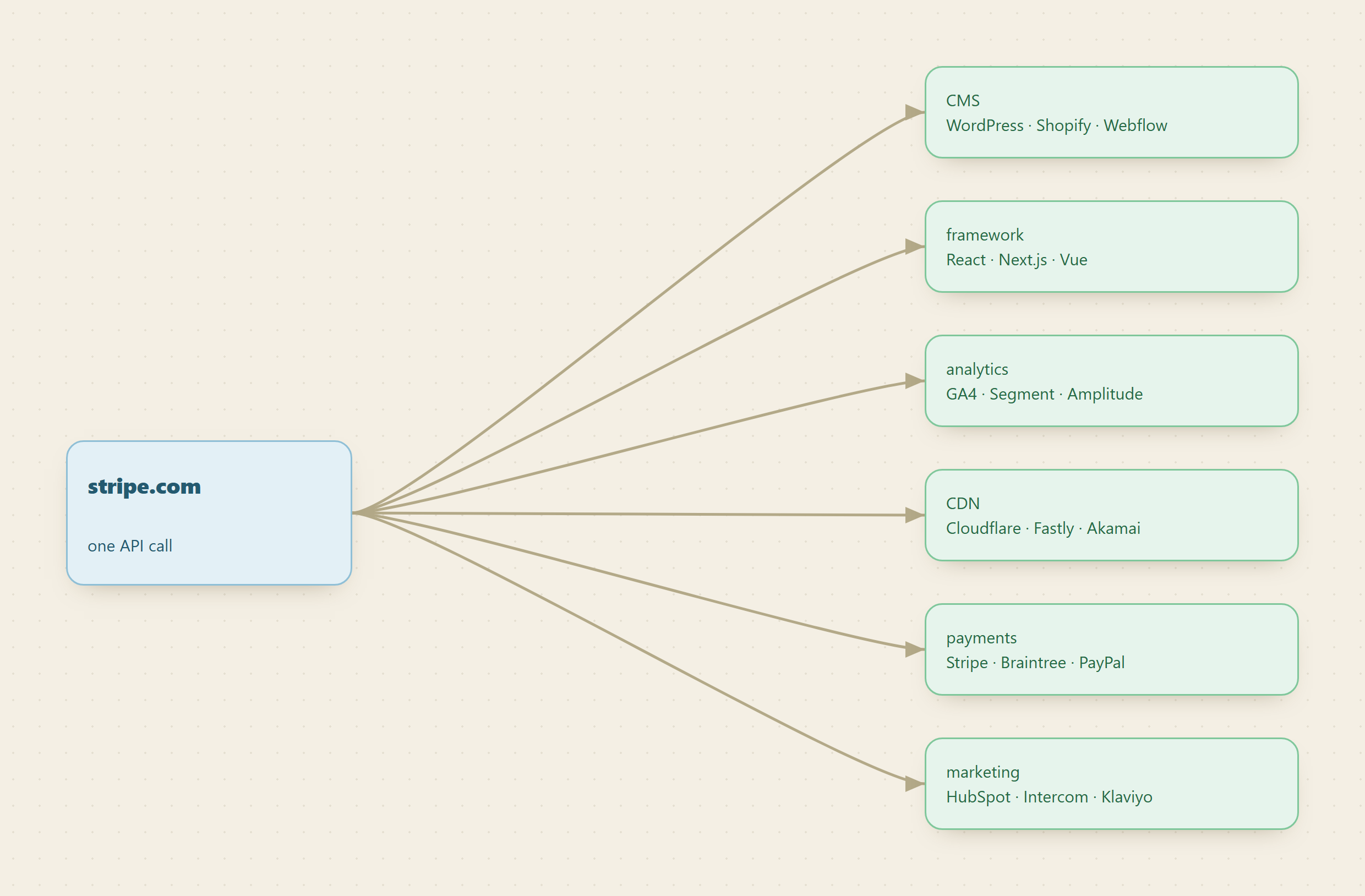
That fan-out is the whole value. A single call turns one bare domain into a set of typed signals you can filter on, and each signal maps to a real qualification question. A framework tells you how modern the front end is. A payment provider tells you whether they sell online and how. An analytics or tag-manager footprint tells you how instrumented their marketing is. A CMS tells you who builds their site and how much they can change. You are not reading a homepage, you are reading a company's technology posture in one structured response.
The endpoint we use for this on Monid is api.strale.io, at /x402/tech-stack-detect. It is a GET call that takes either a domain (like stripe.com) or a full url (like https://stripe.com), and it bills per call: one detection, one price, no base fee. Inspect the schema first, which is free, then run one:
monid inspect -p api.strale.io -e /x402/tech-stack-detect
monid run -p api.strale.io -e /x402/tech-stack-detect --query '{"domain":"stripe.com"}' -w
Enterprise technographic platform, or per-domain API call?
Here is the honest fork, and it is the real reason this page exists. The names most people know, ZoomInfo, HG Insights, BuiltWith, Wappalyzer, Cognism, are not just "detection." They are managed datasets: millions of companies profiled, technology adoption tracked over years, intent signals layered on top, and the whole thing joined to firmographics like headcount, revenue, and industry. That is a genuinely different product from reading one live domain, and for a genuinely different job.
| Enterprise technographic platform | Per-domain API (strale on Monid) | |
|---|---|---|
| Core shape | Managed dataset of millions of companies | One live detection per domain, on demand |
| Best for | Market sizing, install-base trends, intent | "What is this account running, right now" |
| History | Years of adoption trend data | Point-in-time snapshot, no back history |
| Firmographic join | Built in (headcount, revenue, industry) | Pair it yourself with an enrichment call |
| Coverage model | Pre-crawled database you query | Live read of the domain you pass |
| Cost shape | Annual seat or platform contract | Pay per call, zero when idle |
| Fits usage that is | Steady, broad, analyst-driven | Live, bursty, per-account, agent-driven |
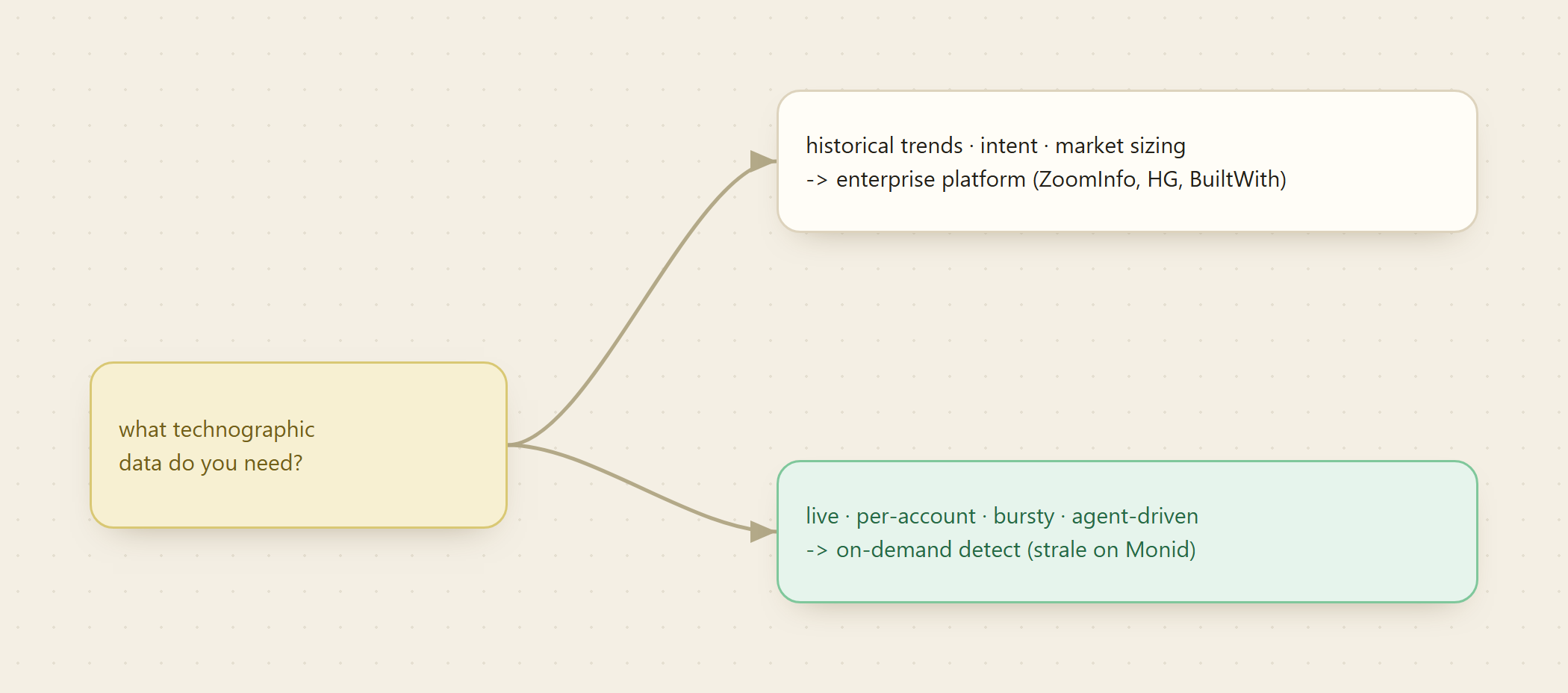
Read that table as a decision, not a scoreboard. If your question is "how many companies in this segment adopted a given tool over the last three years, and which of them are showing buying intent," you want the platform, and no per-call endpoint will fake a historical database you can query in bulk. That is what the annual contract buys, and it is worth it when that is the job.
The per-domain call wins on the other axis: when the need is live, bursty, per-account, or driven by an agent. Score an inbound signup by whether the company runs Shopify before routing it. Qualify an ICP list by whether targets are on HubSpot or Stripe. Enrich a CRM row the moment a domain lands, with the stack it runs today rather than whatever a dataset last crawled. Those jobs do not want a seat you pay for between campaigns. They want one endpoint that answers now and costs nothing while idle.
How do you score a prospect list by tech stack?
The common shape is this: you already have a list of prospect domains, and you want to keep only the accounts whose stack signals fit. Feed the domains in one at a time, detect each stack, then filter or score on the technologies that matter to you. If you sell a Shopify app, presence of Shopify is a hard qualifier. If you integrate with HubSpot, a HubSpot footprint moves an account up the queue. If a target runs Stripe, they sell online and your checkout pitch has a hook.

The list itself can come from anywhere, and if you do not have one yet, our ICP prospect search walkthrough covers building the domain set before you score it. Once you have domains, the loop is one call per domain against the same endpoint, swapping the domain value each time:
monid run -p api.strale.io -e /x402/tech-stack-detect --query '{"domain":"stripe.com"}' -w
Because detection bills per call with no base fee, the economics track the list exactly. A few hundred domains is a few hundred cheap calls, and a run that scores a thousand accounts costs what a thousand calls cost and nothing the week after. You are not amortizing a platform seat across a campaign, you are paying for the domains you actually check.
Tech signals get sharper when you pair them with who the company is. A detection tells you they run HubSpot and Stripe; a firmographic enrichment tells you they are a 200-person company doing business in your target region. We walk through joining a domain to that firmographic layer in turn a domain into full firmographics, and the same balance reaches the company enrichment and people enrichment endpoints, so stack plus firmographics plus a contact is three metered calls, not three vendor contracts.
Where does per-domain detection fit an agent or a signup flow?
The per-call shape earns its keep most in two places: an automated flow and an agent. On signup, a new domain arrives and you want to react to its stack before the user finishes onboarding, route the Shopify merchants one way and the enterprise accounts another, or pre-fill a CRM field. That is a single detection call wired into the flow, and we show the pattern end to end in wire a domain to firmographics on signup. The tech-stack call slots into the same spot.
The agent case is where a marketplace beats a vendor account outright. An agent qualifying inbound or building a target list would rather call one endpoint than hold logins to five technographic vendors and juggle their credit balances. Point it at Monid and it learns the whole discover, inspect, run loop on its own from set up https://monid.ai/SKILL.md. For a human, setup is two lines:
npm install -g @monid-ai/cli
monid keys add --label main --key <your-api-key>
From there the agent inspects the schema for free, confirms that domain and url are the inputs, and only spends when it runs a detection on a real domain. No seat, no minimum, no vendor console to manage between bursts.
What does this cost, and what can it not see?
We do not print rates, because the number that matters is cost per domain checked, and live magnitudes sit at monid.ai/tools. The reasoning that survives any price change: detection bills per call with no base fee, so it lands in the fraction-of-a-cent range per domain, and scoring a few thousand domains for a campaign sits in the low single-digit dollars, dropping to zero the moment the run ends. An enterprise platform can be the better deal when you need its dataset and use it heavily every day, because the contract buys history and intent and bulk that a per-call read does not. Below that, and especially when usage is bursty, per-call wins on the total you actually pay.
Now the caveat that matters more than price. Detection reads what a public HTTP response and its HTML reveal: headers, script tags, meta tags, and recognizable patterns. That means it catches client-visible and header-visible technology well, the CMS, the front-end framework, the analytics and tag managers, the CDN, the payment and marketing tags that load in the browser. It cannot see a private backend a site does not expose, the database, the internal services, the tools that never touch the public response. And it is a point-in-time snapshot of what the domain serves when you call, not a historical record of what it ran last year. If your job needs the hidden backend or the multi-year adoption trend, that is exactly the job the enterprise dataset is for. If your job is "what is this domain visibly running, right now," the public surface is the right surface, and one call reads it.
Conclusion
The best technographic data API for scoring accounts is not a platform seat at all: it is one metered detection per domain, cast across the list you actually care about, paid for by the call and free the moment you stop.
Two things matter more than the endpoint you pick. A null is not a negative. Detection is high-precision and low-recall, so an empty analytics field says the detector did not find analytics on the page it read, not that the company runs none, and any scoring rule that treats empty as "does not use" will be confidently wrong. And what comes back skews toward infrastructure: when we ran the deeper /x402/company-tech-stack endpoint on a large SaaS domain, half its fields came back empty and everything it did detect sat at the CDN, hosting and email layer. We wrote that measurement up in platforms versus one call, and it is the honest counterweight to this page.
Start with the free part: monid inspect prints the schema and price for either endpoint without spending. Then run twenty domains whose stack you already know and count the fill rate on the fields you actually care about. That number is your real coverage rate, and it is the one no vendor page publishes. Begin at monid.ai.
FAQ
What is a technographic data API?
It is an endpoint that takes a domain and returns the technologies that company runs: CMS, framework, analytics, CDN, payment providers, and marketing tools. The strale endpoint on Monid does this per call by reading the domain's public HTTP headers and HTML, returning a structured stack for one domain at a time.
How do I detect a website's tech stack from a list of domains?
Call /x402/tech-stack-detect on api.strale.io once per domain, passing each domain in the query, then filter or score the results by the technologies that signal fit. Detection bills per call with no base fee, so the cost tracks the size of your list rather than a platform seat.
What is the difference between tech-stack-detect and company-tech-stack?
They are two endpoints from the same provider at different depths. /x402/tech-stack-detect is the light read described on this page: headers, tags, recognizable patterns, priced for scoring a long list. /x402/company-tech-stack is a deeper analysis at a substantially higher price per call, and in our measured run it still left half its fields empty. Inspect both before committing a batch to either.
Is this the same as ZoomInfo or BuiltWith?
No, and that is the point. Those are managed datasets built for historical trends, install-base market sizing, and intent signals across millions of companies. The per-domain API answers "what is this one domain running, right now", live and metered, which is a different job that does not need a dataset or a contract.
What can tech stack detection not see?
Anything the public response does not expose. It reads client-visible and header-visible technology, so it cannot detect a private backend, an internal database, or services that never appear in the HTML or headers. In practice it also misses much of the application layer, because tag managers hide analytics, checkout-only scripts hide payment processors, and compiled bundles hide frameworks. It is a point-in-time snapshot, not a record of what the site ran in the past.
Last updated September 2026.